

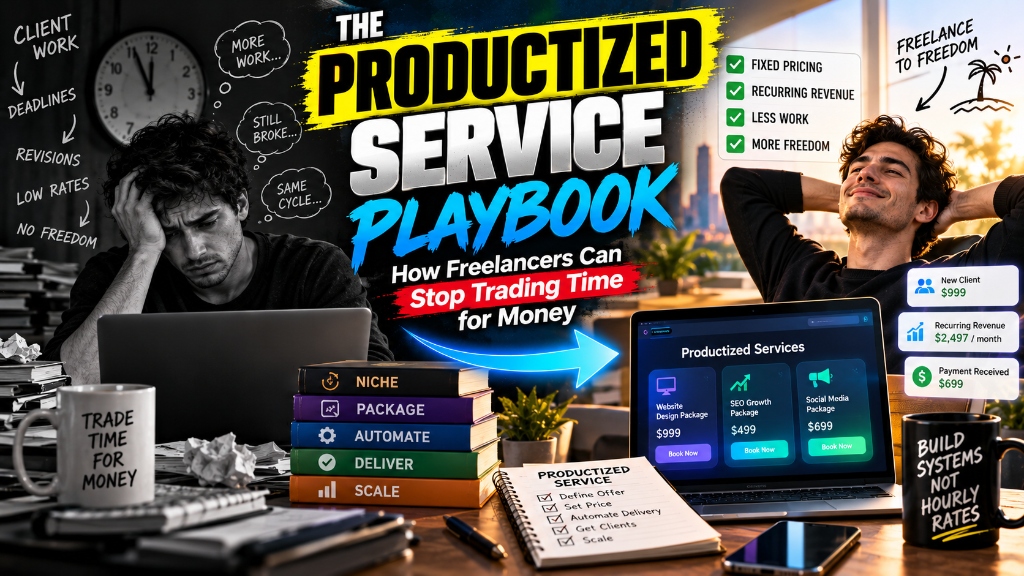
The Productized Service Playbook: How Freelancers Can Stop Trading Time for Money
Escape the hourly billing trap with the productized service model for freelancers. Standardize deliverables, eliminate proposals, and scale predictable revenue.
Educational Resource: This guide does not constitute financial or legal counsel.
Direct Answer: The productized service model for freelancers is a business framework where custom, hourly consulting is converted into a standardized service with a fixed scope, flat pricing, defined turnaround times, and self-serve onboarding. By eliminating custom proposals and scope creep, solo operators scale revenue predictably while decoupling earnings from billable hours.
Hourly freelancing is a trap disguised as independence.
When you bill by the hour, you are trapped in an inverted incentive structure: the more experienced, efficient, and skilled you become, the fewer hours a project takes you, and the less money you make for delivering superior work. To earn more, your only options are working eighty-hour weeks or pitching higher hourly rates that trigger client resistance.
Worse still, traditional freelancing forces you onto an exhausting feast-or-famine rollercoaster. You spend two weeks writing custom twenty-page proposals, pitching prospects on unpaid discovery calls, and negotiating scopes, only to scramble frantically to fulfill the work once contracts are signed.
The path to building a high-margin, predictable solo business is the productized service model. By transforming your expertise into a packaged product with a fixed price and automated onboarding, you stop selling time and start selling guaranteed business outcomes.
Here is the exact framework to productize your consulting, build an automated client intake funnel, and replace custom pitches with recurring retainers.
The Structural Ceiling of Custom Proposals and Hourly Billing
Custom proposals and hourly billing cap freelance revenue by wasting up to 40% of non-billable working hours on sales friction and scope creep.
When you offer bespoke services (“I build websites, write copy, or design anything you need”), every new client engagement requires starting from scratch:
- Unpaid Discovery Fatigue: You conduct 45-minute consultation calls, review confusing legacy assets, and draft unique statements of work that prospects frequently ghost or shop to cheaper competitors.
- Uncontrolled Scope Creep: Vague project boundaries lead clients to demand “just one small tweak,” dragging a three-week engagement into a three-month administrative nightmare.
- Unpredictable Revenue Trajectory: Because every project has an arbitrary start and finish date, your bank account swings wildly from $12,000 one month to $1,800 the next.
Standardizing your service into a repeatable package eliminates this friction entirely. Clients do not buy your hours; they buy the specific business problem you solve.
The Single Outcome Formula: Identifying Your Most Repeatable High-Value Skill
The single outcome formula requires identifying the one specific deliverable you produce faster, better, and with more consistent client satisfaction than any other.
Do not attempt to productize your entire catalog of skills at once. Generalist offerings like “Full-Stack Web Development as a Service” are too broad to price effectively and attract demanding, unfocused buyers.
Instead, look across your past six to twelve months of freelance projects and pinpoint the single deliverable where client eyes lit up and where your execution felt systematic. Use this three-part evaluation filter:
- High Commercial Value: Does the output directly increase revenue, save significant operational time, or de-risk compliance for the buyer? (For example: high-converting landing page teardowns or automated Stripe billing pipelines).
- Definable Deliverable: Can the finished product be described in two concrete sentences? (For instance: “We migrate your entire Mailchimp database to Klaviyo and build your top 3 automated revenue flows in 7 days.”)
- Repeatable Workflow: Can 70% of the underlying production process be templated, automated with software, or delegated to a junior specialist?
Examples of highly successful productized services include:
- DesignJoy: Unlimited UI/UX design requests for a flat monthly subscription.
- Scribly: Standardized, done-for-you content marketing and blog writing packages.
- Draft: High-converting landing page copywriting delivered in five business days.
Packaging Your Service: Defining Scopes, Boundaries, and Turnaround Times
Packaging a service successfully requires establishing crystal-clear scope constraints, unambiguous deliverables, and rigid turnaround timelines.
Ambiguity is the enemy of fixed-price profitability. When you define your package, document exactly what is included, what is strictly excluded, and how revisions are handled:
1. The Core Deliverable Specification
List the exact components delivered. For a productized SEO audit, specify: “A 25-point technical crawl report, a prioritized Loom video walkthrough, and an exportable CSV of 10 targeted keyword content briefs.”
2. Explicit Scope Exclusions (The “What We Do Not Do” Section)
Protect your operational sanity by listing exclusions clearly on your sales page:
- “We do not write custom code or implement CMS changes directly.”
- “We do not manage third-party ad spend budgets.”
- “We do not attend ad-hoc daily Zoom meetings; all asynchronous communication occurs via our client portal.”
3. Strict Turnaround Guarantees
Give clients certainty by specifying delivery deadlines: “Delivered within 72 business hours of onboarding form submission.” Fast, predictable turnarounds command premium prices because clients value speed and operational reliability above all else.
Pricing Architectures: One-Off Sprints vs. Monthly Recurring Retainers
Productized services thrive on two primary pricing architectures: the fixed-price intensive sprint and the recurring monthly subscription retainer.
Model A: The Fixed-Price Intensive Sprint
The client pays a single upfront fee (typically $1,500 to $5,000) for a tightly defined, high-impact outcome completed in 3 to 10 days.
- Best For: Audits, strategic roadmaps, foundational migrations, and launch assets.
- Advantage: Low barrier to entry for cautious clients who want to sample your work before committing to ongoing contracts.
Model B: The Monthly Subscription Retainer
The client pays an ongoing recurring fee (typically $2,500 to $7,500 per month) for continuous execution with a “one active request at a time” policy.
- Best For: Continuous design, ongoing newsletter management, code maintenance, and weekly video editing.
- Advantage: Builds predictable Monthly Recurring Revenue (MRR), transforming your solo practice into a stable agency model where client retention replaces daily outbound prospecting.
Comparison Table: Hourly Freelancing vs. Bespoke Agency vs. Productized Service
| Operational Dimension | Hourly Freelancing | Bespoke Digital Agency | Productized Service Model |
|---|---|---|---|
| Pricing Structure | $50 to $150 / billable hour | Custom estimates per project | Transparent, flat-rate pricing |
| Sales Cycle Length | 2 to 4 weeks (proposals & calls) | 1 to 3 months (pitches & RFPs) | Self-serve checkout (0 to 48 hrs) |
| Delivery Predictability | Erratic and scope-dependent | Prone to major project delays | Standardized SLA (e.g., 48–72 hrs) |
| Client Communication | Constant ad-hoc Zoom meetings | Multi-layered account managers | Asynchronous portal (Trello/Notion) |
| Profit Margins | Hard ceiling based on hours worked | Compressed by high staff overhead | High (60% to 85%+ margins) |
| Revenue Predictability | High feast-or-famine volatility | Lumpy enterprise retainers | Stable MRR from recurring subscriptions |
The Tech Stack for Self-Serve Client Intake (Stripe, Trello, Notion, ManyRequests)
A lean productized tech stack automates client payments, intake questionnaires, and request pipelines without custom software engineering.
You can launch a fully functional productized service in a single weekend using modern no-code software:
- Front-End & Checkout (Webflow / Framer + Stripe): Build a clean, three-page website detailing your package, pricing tiers, and FAQ. Embed direct Stripe checkout links or Lemon Squeezy subscription buttons so clients can purchase directly without an introductory call.
- Client Portal & Request Management (ManyRequests / Copilot): For a professional, all-in-one client experience, use dedicated portal software like ManyRequests or Copilot. These tools handle recurring invoicing, file delivery, task queues, and messaging under your custom domain.
- Lean Alternative (Trello / Notion + Tally Forms): If you prefer a zero-overhead stack, configure a Stripe payment success redirect that points directly to a Tally form. The completed form automatically creates a new card on a private Trello or Notion kanban board with columns for
Backlog,In Progress,Review, andCompleted.
By eliminating sales calls and automating client onboarding, a client can discover your website at 11:00 PM, enter their credit card, complete their intake requirements, and queue work on your production board while you sleep.
Real-World Case Study: How a Copywriter Scaled from $4k to $18k Per Month
Standardizing bespoke writing into a fixed-scope email newsletter retainer allowed one freelance copywriter to quadruple their revenue while reducing weekly hours.
Mark S. had spent four years freelancing as a general marketing copywriter. He charged $75 per hour, wrote blog posts, drafted white papers, and created social posts. Despite working 50 hours each week, his income plateaued around $4,000 to $5,000 per month due to unpaid pitch calls, administrative revisions, and client invoicing delays.
In late 2025, Mark restructured his entire business around the productized model:
- The Single Deliverable: He retired all general copywriting and offered only one deliverable: “The Weekly E-Commerce Retention Newsletter Engine.”
- The Package: For a flat fee of $2,200 per month, he wrote, designed, and scheduled four weekly email campaigns for direct-to-consumer Shopify brands.
- The Scope Boundary: Exactly four emails per month. Revisions were submitted via Loom and limited to one round within 48 hours. Zero strategy meetings.
- The Result: Within four months, Mark signed eight e-commerce clients to monthly retainers, scaling his revenue to $17,600 per month. Because his production pipeline was standardized around Klaviyo templates, he completed all client deliverables in roughly 25 focused hours per week, achieving both financial security and genuine time freedom.
Frequently Asked Questions
Can you build a productized service without an existing audience?
Yes, you do not need an existing social media audience to launch a productized service. You can validate your offer by pitching your previous happy freelance clients, reaching out directly to niche businesses with personalized Loom video audits, or partnering with complimentary agencies that lack your specific fulfillment capability.
What if a client submits an impossible or unreasonable request?
Clear Terms of Service and intake boundaries prevent unreasonable requests. If a client submits a task that falls outside your published package boundaries, politely pause the ticket and offer two choices: break the request down into your standardized scope parameters or refer them to a trusted custom agency partner.
Should I completely eliminate discovery calls?
For entry-level packages under $1,500, self-serve checkout should be the default. For high-ticket monthly subscriptions ($3,000 to $5,000+ per month), offering a structured 15-minute “Fit and Scope Assessment” call can increase conversion rates, provided the call focuses on vetting the client rather than pitching bespoke solutions.
How do I transition existing hourly clients to a productized retainer?
Notify your existing clients 30 days in advance that your business model is evolving to deliver faster, higher-quality outcomes. Present your new packaged retainer, highlight the benefits (priority scheduling, guaranteed turnarounds, and flat predictable invoicing), and offer a legacy discount for their first three months.
When should I hire subcontractors to fulfill the work?
You should hire skilled subcontractors once your personal fulfillment hours reach 70% of your maximum weekly capacity (typically when your MRR crosses $8,000 to $12,000). Document your standard operating procedures (SOPs) into Loom videos and Notion docs so contractors can fulfill the standardized steps while you focus on quality control and growth.
Final Thoughts: Designing a Business That Works for You
Freelancing was supposed to provide autonomy, yet most freelancers end up with twenty demanding bosses and the stress of continuous unpaid sales pitching.
The productized service model offers a proven escape route. By standardizing your deliverable, setting firm scope boundaries, and allowing clients to buy your expertise like software, you eliminate billing anxiety and build an asset with genuine enterprise value.
Identify your single best skill this week, draft your package boundaries, set up your Stripe checkout link, and stop trading your irreplaceable time for billable hours.
Download: The Solo Founder's High-Margin Scaling Playbook
A battle-tested blueprint on building asymmetric leverage, packaging high-ticket B2B services, and converting labor into scalable digital products.
- Pricing power & contract negotiation scripts
- Micro-SaaS & digital product launch checklist
This article and its associated calculators are for educational and informational purposes only and do not constitute financial, investment, legal, tax, or medical advice. We may earn an affiliate commission on third-party links at zero cost to you. Always consult a licensed professional before making major financial, health, or investment decisions. Read our full Legal & Financial Disclaimer.
Vikram Nair
Verified AuthorVikram covers small business ideas, digital ventures, and practical company growth. Having worked alongside early-stage founders, he writes straightforward advice on building profitable businesses.
Was this essay valuable to you?
Help us refine our editorial focus and research priorities.
Reader Discussion (2)
Extremely well-articulated analysis on capital compounding. The breakdown on equity allocation vs active income is spot on.
The distinction between looking rich and building real moats is something more founders need to study deeply.
Explore Eternity Empire
Search empirical insights, explore our four wisdom categories, and discover curated strategic essays.
Search Insights
Recent Essays
The Backyard Cash Flow Engine: How to House Hack with an ADU in 2026
11 min read • Oct 20How to Become a Fractional COO: Landing Your First $5,000/Month Retainer Client
12 min read • Oct 20The Zero-Bounce Outbound Engine: How to Set Up Multi-Domain Cold Email with Instantly and Clay
12 min read • Oct 20Featured Guides
Further Wisdom & Insights
Explore All Articles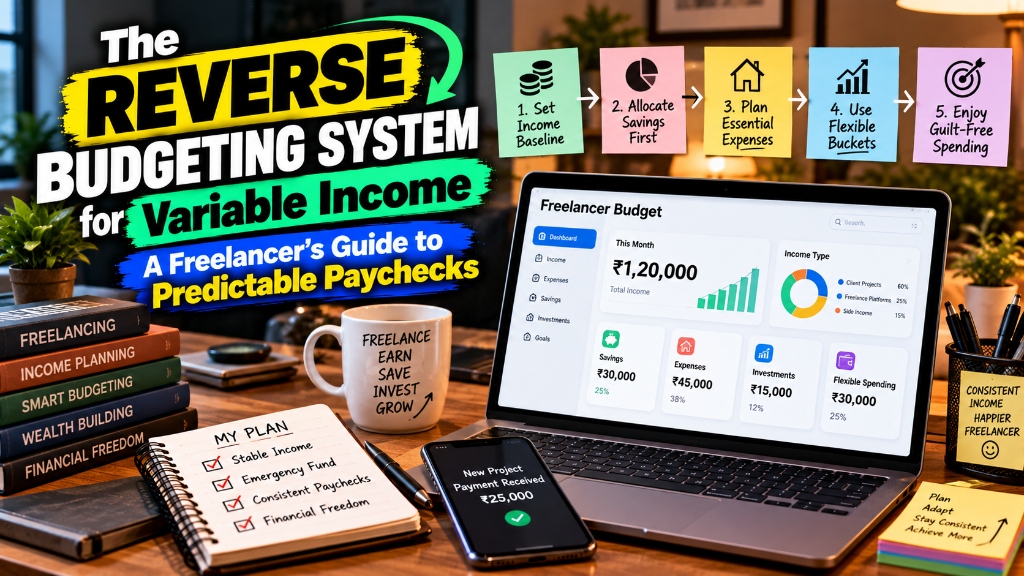
The Reverse Budgeting System for Variable Income: A Freelancer's Guide
Master reverse budgeting for variable income. Learn how freelancers turn erratic client checks into predictable bi-weekly paychecks with buffer accounts.

Wise vs. Revolut Business: Which Account Saves Global Freelancers the Most on FX and Transfer Fees?
Compare Wise vs Revolut Business for international freelancers. Analyze exchange rate markups, SWIFT wire costs, weekend FX fees, and accounting sync.

When to Elect S-Corp Status for Your LLC: The $80,000 Profit Rule and Reasonable Salary Math
Discover when to elect S-Corp for single member LLC status. Learn the $80,000 net profit threshold, reasonable salary rules, and Form 2553 filing deadlines.