

How to Reach Financial Independence in India: Calculate Your FIRE Number
Calculate your FIRE number in India for 2026. Learn safe withdrawal rates, Indian inflation reality, Lean vs Fat FIRE, and interactive portfolio modeling.
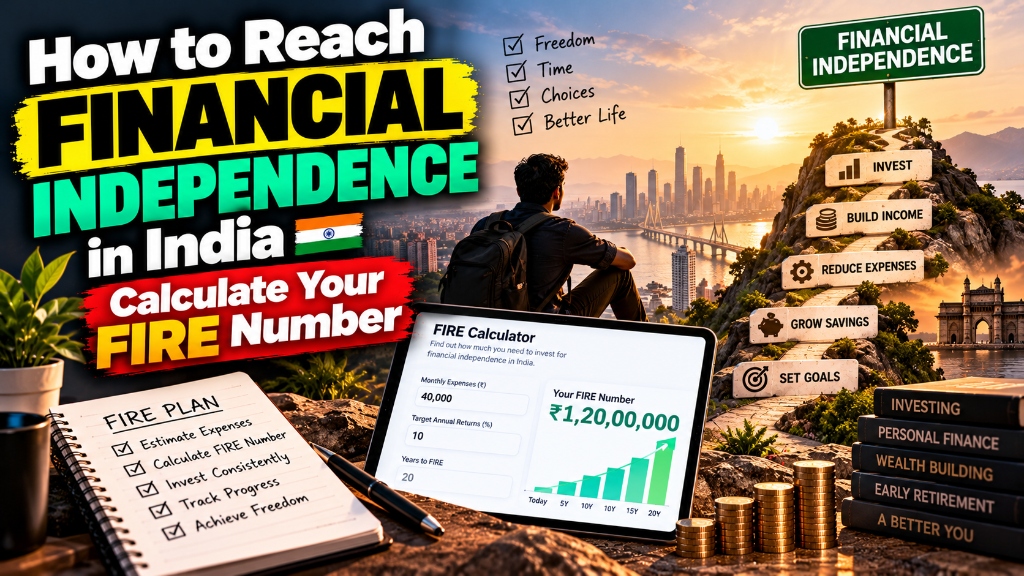
Educational Resource: This guide does not constitute financial or legal counsel.
Reaching Financial Independence, Retire Early (FIRE) in India requires accumulating a diversified investment portfolio between 30 and 40 times your projected annual living expenses. Because Indian retail inflation averages 6% and healthcare costs climb faster, relying on the Western 4% withdrawal rule carries severe risk; a conservative 2.75% to 3.25% safe withdrawal rate is far safer.
The global Financial Independence, Retire Early (FIRE) movement has gained massive momentum among Indian salaried professionals who feel burnt out by toxic corporate cultures and endless commutes.
However, copying Western FIRE calculations directly into the Indian financial landscape is a dangerous recipe for retirement failure. In the United States, FIRE enthusiasts frequently base their planning on the famous Trinity Study, which assumes a 4% safe withdrawal rate against a stable 2.5% long-term inflation rate. In India, retail consumer price inflation averages 5.5% to 7.0%, private education costs rise at 10% annually, and specialized medical procedures experience double-digit inflation.
Retiring early in India is entirely achievable, but it demands an inflation-adjusted framework, customized corpus modeling, and a resilient multi-bucket asset allocation. Use this complete guide and our interactive calculator below to compute your true Indian FIRE number.
What Is the FIRE Movement and What Does Your FIRE Number Mean?
Your FIRE number is the total net worth in income-generating liquid assets required to cover all living expenses for the rest of your life without ever needing to earn an active paycheck.
The philosophy behind FIRE is not necessarily about sitting on a beach doing nothing for forty years. For most professionals, financial independence is about reclaiming absolute autonomy over your time: having the freedom to leave a hostile workplace, launch a passion business, spend time with aging parents, or consult on your own terms without anxiety over monthly bills.
Your required corpus depends primarily on two factors: your realistic annual household burn rate and your chosen Safe Withdrawal Rate (SWR). You can test different withdrawal rates instantly using our free FIRE calculator.
Interactive FIRE Calculator
Use our dedicated financial calculator to determine your target corpus, project your years to retirement, and simulate different savings rates.
Interactive Indian FIRE & Early Retirement Calculator
Compute your customized Indian FIRE number, test Safe Withdrawal Rates between 2.5% and 4.0%, factor in 6% domestic retail inflation, and model how many years of disciplined compounding you need to reach complete financial independence.
You can also explore our dedicated FIRE calculator tool to model extended forty-year post-retirement timelines and stress-test your portfolio across market cycles.
The 5 Flavors of FIRE in India: From Lean to Fat
Financial independence is not a one-size-fits-all target; it adapts directly to your lifestyle choices, city of residence, and family responsibilities.
The table below breaks down the five primary tiers of financial independence in India, showing the required expense multiple, realistic monthly expenditure in a major metropolitan city, target corpus requirements, and lifestyle trade-offs.
| FIRE Tier | Annual Expense Multiple | Realistic Monthly Spending (Tier-1 City) | Target Investment Corpus (2026) | Lifestyle Realities & Assumptions | Risk Buffer Level |
|---|---|---|---|---|---|
| Lean FIRE | 25x to 30x basic expenses | ₹40,000 to ₹60,000 | ₹1.5 Crore to ₹2.0 Crore | Frugal living, tier-2/3 relocation, zero luxury travel, public transit | Low (Tight margin for error) |
| Standard FIRE | 30x to 35x full expenses | ₹1,00,000 to ₹1,50,000 | ₹3.5 Crore to ₹5.0 Crore | Comfortable lifestyle, family health insurance, annual domestic vacations | Moderate (Healthy baseline) |
| Fat FIRE | 40x to 50x generous expenses | ₹2,50,000 to ₹4,00,000+ | ₹10.0 Crore to ₹18.0 Crore | Premium housing, private international schooling, overseas vacations | High (Substantial shock absorber) |
| Barista FIRE | 15x to 20x expenses + part-time income | ₹50,000 (Subsidized by part-time work) | ₹1.0 Crore to ₹1.5 Crore | Passive portfolio covers baseline bills; part-time work covers fun & insurance | Moderate |
| Coast FIRE | Early compounding cushion | Existing living expenses | ₹40 Lakh to ₹80 Lakh by age 30 | Accumulated savings grow to fund traditional retirement; current income covers today’s bills | High (Zero early retirement, but low career stress) |
Why the US “4% Rule” Fails in India: The Real Safe Withdrawal Rate
The traditional 4% safe withdrawal rate fails in India because high domestic inflation and volatile currency exchange rates erode purchasing power much faster than in Western economies.
The 4% rule was established by the 1998 Trinity Study, which backtested historical US stock and bond returns over a standard 30-year retirement window. If you retire early in India at age 35 or 40, your portfolio must survive for 45 to 50 years, not 30. During a five-decade horizon, high inflation acts as a relentless destroyer of real capital.
For an early retirement in India:
- The 4% Rule (25x expenses) carries an estimated 25% to 35% probability of portfolio depletion over forty years if you encounter a market crash during your first five years of retirement (known as Sequence of Returns Risk).
- A 3.0% to 3.25% Withdrawal Rate (30x to 33x expenses) provides a robust 90%+ success rate, allowing your equity growth to comfortably stay ahead of general consumer price increases.
- A 2.5% to 2.75% Withdrawal Rate (36x to 40x expenses) is virtually bulletproof, ensuring that your capital not only lasts indefinitely but leaves a sizable generational inheritance.
The Formula: How to Calculate Your Indian FIRE Number Step-by-Step
Calculating your customized FIRE target requires a structured four-part equation rather than a single back-of-the-envelope guess.
Step 1: Calculate Your True Baseline Annual Household Expenses
Calculating your true annual expenses requires summing twelve months of all living costs, including hidden and irregular annual payments.
Do not look only at your monthly grocery and utility bills. Ensure you include:
- Core living costs: Rent or property maintenance, groceries, electricity, broadband, mobile bills.
- Irregular annual expenses: Vehicle insurance, home repairs, festival shopping, family wedding gifts.
- Healthcare and insurance premiums: Comprehensive family floater medical insurance and super-top-up policies.
- Annual discretionary spending: Weekend dining, hobby equipment, domestic vacations.
For example, if your family spends an average of ₹1,00,000 per month on living costs plus ₹2,00,000 on annual irregular items, your true baseline annual expense is:
Annual Baseline Expenses Calculation:
(₹1,00,000 monthly expenses x 12) + ₹2,00,000 irregular items = ₹14,00,000 per year
Step 2: Multiply by Your Target SWR Multiple
Multiplying your baseline expenses by 33 (a 3.0% withdrawal rate) establishes your core income-generating portfolio requirement.
Core Retirement Portfolio Target:
₹14,00,000 annual baseline expenses x 33 (3.0% SWR) = ₹4,62,00,000 (₹4.62 Crore)
Step 3: Add Separate One-Off Future Milestone Funds
Adding separate, dedicated capital pots for major milestone events prevents you from cannibalizing your daily monthly withdrawal bucket.
Your recurring annual expenses should never be forced to absorb massive, one-off capital outlays. Calculate separate target sums for:
- Children’s Higher Education & Marriage Fund: For instance, ₹50 Lakh to ₹1 Crore per child invested in child-specific equity mutual funds.
- Paid-Off Primary Residence: You should own your primary home debt-free before pulling the retirement trigger so your monthly burn rate remains free of unpredictable rental hikes.
- Emergency Medical Catastrophe Reserve: A dedicated liquid reserve of ₹25 Lakh to ₹50 Lakh outside your health insurance cover.
Step 4: Sum the Components for Your Final FIRE Number
Total Comprehensive Indian FIRE Target:
Core Portfolio (₹4.62 Crore) + Child Education Fund (₹75 Lakh) + Medical Reserve (₹25 Lakh) = ₹5.62 Crore
You can calculate your customized retirement corpus and test withdrawal rate sensitivities using our interactive FIRE Calculator India. For real-number case studies, review our roadmap for FIRE with ₹1 Lakh Monthly Expenses or our comprehensive guide on How to Retire at 40 in India.
The Bucket Strategy: How to Draw Down Money in Retirement
The 3-bucket strategy protects early retirees from selling equity assets during market downturns by keeping multiple years of living expenses in safe, liquid reserves.
- Bucket 1: Immediate Cash (Years 1 to 3): Keep two to three years of living expenses in high-interest savings accounts, liquid mutual funds, and short-term fixed deposits. All daily withdrawals come directly from this zero-volatility reservoir.
- Bucket 2: Fixed Income & Yield (Years 4 to 8): Allocate five to six years of expenses into senior secured corporate bonds, RBI floating rate bonds, and conservative debt funds yielding 7% to 8.5%. This bucket periodically replenishes Bucket 1.
- Bucket 3: Pure Growth & Compounding (Years 9+): Keep the remaining 60% of your portfolio invested in diversified equity mutual funds, Nifty 50 index funds, and REITs. Because you have eight years of expenses protected in Buckets 1 and 2, you never have to panic or sell equities during a temporary stock market correction.
3 Critical Risks That Derail Early Retirees in India
Understanding systemic hazards allows you to build defensive contingencies into your asset allocation before resigning from your corporate job.
- Sequence of Returns Risk (SRR): If the stock market drops 25% during the first three years of your retirement and you are forced to sell equity units to pay for groceries, your portfolio may never recover mathematically. The multi-bucket structure solves this hazard completely.
- Severe Healthcare Inflation: Medical inflation in Indian private healthcare systems routinely clocks between 12% and 14% annually. Maintaining a primary family health insurance policy of ₹15 Lakh paired with a ₹1 Crore Super Top-Up policy is mandatory for every early retiree.
- Lifestyle Inflation and Boredom: Many corporate workers retire early to escape burnout, only to discover that unstructured free time leads to boredom and expensive new hobbies that inflate their monthly burn rate. Cultivating low-cost creative pursuits, physical fitness habits, and intellectual curiosity before retiring is vital for mental health.
Frequently Asked Questions
Is 3 Crore enough for FIRE in India?
Yes, ₹3 Crore can support a comfortable Lean-to-Standard FIRE lifestyle in India for an individual or couple spending ₹80,000 to ₹90,000 per month, assuming a debt-free primary residence and adequate health insurance.
What is a realistic safe withdrawal rate for early retirement in India?
A safe withdrawal rate of 2.75% to 3.25% (or a corpus multiple of 30x to 36x annual expenses) is realistic for India, as it provides a safety buffer against high inflation and lengthy 40-year retirement horizons.
What is the difference between Lean FIRE and Fat FIRE?
Lean FIRE covers only basic survival expenses (housing, food, utilities) on a tight budget, while Fat FIRE provides a luxurious lifestyle with international vacations, upscale housing, and zero lifestyle compromises.
Should I pay off my home loan before achieving FIRE?
Yes, owning your primary residence debt-free before early retirement eliminates housing rent inflation and removes mortgage default risk from your monthly cash flow. To calculate whether accelerated prepayments beat equity investments for your specific mortgage, test scenarios in our Home Loan Prepayment Calculator.
How does inflation affect my FIRE number over time?
Inflation constantly increases the nominal rupee cost of your annual expenses; an expenditure of ₹12 Lakh today will require approximately ₹21.5 Lakh per year in ten years at a 6% annual inflation rate.
Strategic Takeaway and Action Plan
Reaching financial independence in India is a marathon of consistency, not a speculative sprint.
Calculate your exact household baseline expenses this evening. Once you know your annual burn rate, pick a realistic withdrawal multiple between 30x and 35x, set up your direct mutual fund SIPs, and track your net worth quarterly. To model your exact target corpus and safe withdrawal timeline, run your projections in our interactive FIRE calculator, explore our localized FIRE India Calculator & Guide, test your numbers with our ₹1 Lakh/Month Expenses FIRE Plan, or review the complete Retire at 40 in India Blueprint. To calculate how much wealth your current monthly savings will accumulate over the next decade, simulate your trajectory using our comprehensive compounding calculator and explore our guide on how to build a personal financial system.
Download: The 2026 Wealth Compounding & FIRE Planning Toolkit
Our complete spreadsheet model and 28-page strategic handbook covering asset allocation buckets, Indian inflation adjustments, and long-term SIP compounding.
- Interactive FIRE & Net Worth Excel/Sheets model
- Asset allocation & emergency reserve matrix
This article and its associated calculators are for educational and informational purposes only and do not constitute financial, investment, legal, tax, or medical advice. We may earn an affiliate commission on third-party links at zero cost to you. Always consult a licensed professional before making major financial, health, or investment decisions. Read our full Legal & Financial Disclaimer.
Aditya Singhania
Verified AuthorAditya writes about investing, saving habits, and smart money management. With a background in financial planning, he helps readers build simple, reliable wealth habits for the long run.
Was this essay valuable to you?
Help us refine our editorial focus and research priorities.
Reader Discussion (2)
Extremely well-articulated analysis on capital compounding. The breakdown on equity allocation vs active income is spot on.
The distinction between looking rich and building real moats is something more founders need to study deeply.
Explore Eternity Empire
Search empirical insights, explore our four wisdom categories, and discover curated strategic essays.
Search Insights
Recent Essays
The Backyard Cash Flow Engine: How to House Hack with an ADU in 2026
11 min read • Oct 20How to Become a Fractional COO: Landing Your First $5,000/Month Retainer Client
12 min read • Oct 20The Zero-Bounce Outbound Engine: How to Set Up Multi-Domain Cold Email with Instantly and Clay
12 min read • Oct 20Featured Guides
Further Wisdom & Insights
Explore All Articles
Coast FIRE Explained: How to Frontload Retirement and Downshift Work in Your 30s
Master the Coast FIRE calculator and milestone strategy. Learn the exact math to frontload retirement savings and downshift into low-stress work in your 30s.

How to Make Passive Income in India in 2026: 10 Realistic Ways to Start
Discover 10 realistic passive income ideas in India for 2026. Compare capital requirements, upfront effort, tax implications, and expected returns.

The HSA Shoebox Strategy: How to Turn a Health Savings Account into a Tax-Free Stealth IRA
Master the HSA shoebox strategy to turn healthcare savings into a tax-free stealth IRA. Learn delayed reimbursement rules, record-keeping, and custodian picks.