

Coast FIRE Explained: How to Frontload Retirement and Downshift Work in Your 30s
Master the Coast FIRE calculator and milestone strategy. Learn the exact math to frontload retirement savings and downshift into low-stress work in your 30s.
Educational Resource: This guide does not constitute financial or legal counsel.
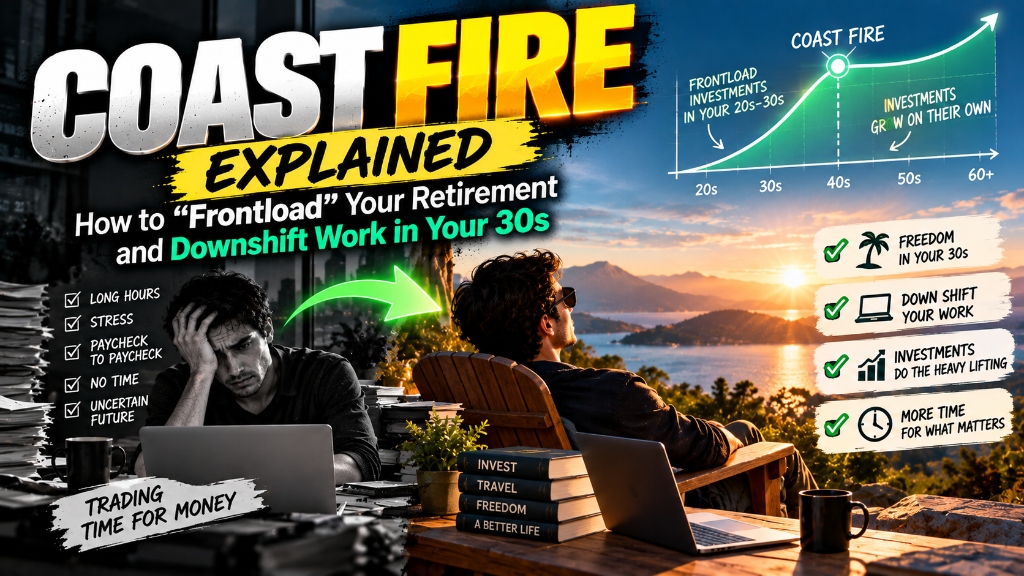
Direct Answer: The Coast FIRE calculator and milestone strategy is a financial independence framework where you aggressively save and invest capital early in your career until your portfolio can compound to full retirement security on its own. Once this milestone is reached, you never need to save another dollar for retirement, freeing you to work low-stress jobs that simply cover current living expenses.
The traditional Financial Independence, Retire Early (FIRE) movement is notorious for its punishing asceticism.
To achieve full financial independence in their thirties, standard FIRE adherents often subject themselves to extreme deprivation: living in tiny rooms, eating rice and beans, and saving 70% to 80% of their take-home pay while grinding through 70-hour corporate workweeks. For many, this extreme frugality leads directly to burnout, cynicism, and an empty life long before their portfolio hits twenty-five times annual expenses.
Coast FIRE offers a far more sustainable, human-centric alternative.
Instead of racing to accumulate your entire lifetime retirement portfolio before age 40, you frontload your investments in your twenties or early thirties. Once your invested principal reaches the mathematical threshold where compound interest will carry it across the finish line by age 60 or 65, you downshift immediately.
You no longer need to save for the future. You only need to earn enough to pay for today. Here is how Coast FIRE works, how to calculate your milestone number, and how to execute the transition without sacrificing financial security.
Traditional FIRE vs. Coast FIRE: Why Extreme Deprivation Fails
Traditional FIRE demands accumulating your entire lifetime nest egg upfront, whereas Coast FIRE leverages multi-decade compound growth to handle future retirement needs.
The core vulnerability of traditional FIRE is the enormous sacrifice required during your most energetic, healthy decades. Deferring travel, relationships, hobbies, and career enjoyment until age 40 creates a fragile psychological dynamic:
- Sacrificing Prime Life Years: Sacrificing your youth for a spreadsheet projection often leaves you with accumulated wealth but depleted physical vitality and hollowed-out social networks.
- The Golden Handcuffs Trap: High-earning corporate professionals convince themselves they must endure “just one more year” in toxic environments to pad their net worth.
- The False Binary of All-or-Nothing Work: Traditional retirement assumes a rigid switch between 60-hour corporate drudgery and complete, passive idleness. Most intelligent humans crave purposeful, creative activity; they simply hate arbitrary schedules, long commutes, and bureaucratic politics.
Coast FIRE solves this dilemma by recognizing that work itself is not the problem: work without autonomy is the problem. By funding your retirement early, you reclaim autonomy decades ahead of schedule.
The Math of Compounding: How $100k in Your 20s Grows to Millions Without Adding Another Dime
Compound interest acts as an exponential multiplier over long time horizons, allowing a modest early sum to outgrow decades of late contributions.
Consider the mechanics of compound growth over a 35-year investment horizon. If an ambitious 28-year-old saves aggressively and invests $100,000 into a low-cost total stock market index fund, let us see what happens if they never invest a single additional dollar for the rest of their working life:
- Assumed Real Rate of Return: 7.0% annualized (the historical real return of the U.S. stock market after adjusting for inflation).
- At Age 38 (10 Years In): Portfolio value reaches $196,715.
- At Age 48 (20 Years In): Portfolio value reaches $386,968.
- At Age 58 (30 Years In): Portfolio value reaches $761,225.
- At Age 63 (35 Years In): Portfolio value crosses $1,067,658 in inflation-adjusted purchasing power.
That initial $100,000 grew tenfold entirely through the power of uninterrupted compounding. Because the individual frontloaded their capital at 28, they unlocked 35 consecutive years of freedom where 100% of their ongoing paycheck could be spent on immediate lifestyle desires, family, travel, or passion projects.
Step-by-Step Formula: Calculating Your Exact Coast FIRE Milestone Number
Calculating your exact Coast FIRE milestone number requires working backward from your future retirement spending target using the rule of discounted compounding.
Use this systematic formula to determine your exact target:
Step 1: Determine Your Target Retirement Annual Spending
Estimate your desired annual living expenses in retirement (in today’s dollars). For instance, assume $60,000 per year.
Step 2: Calculate Your Full FIRE Target Portfolio
Apply the standard 4% safe withdrawal rule (multiplying your annual target by 25):
Full FIRE Target = $60,000 × 25 = $1,500,000
Step 3: Identify Your Investment Runway
Determine the number of years remaining between your current age and your traditional retirement age. If you are 30 and plan to let your investments compound until age 65:
Investment Runway (t) = 65 − 30 = 35 years
Step 4: Apply the Discounted Compounding Formula
Discount your target portfolio using an assumed real, inflation-adjusted annual rate of return (r). Historically, 5% to 7% is the standard planning benchmark:
Coast FIRE Milestone = Full FIRE Target / (1 + r)t
Using a conservative 6% real annual return over 35 years:
Coast FIRE Milestone = $1,500,000 / (1 + 0.06)35 = $1,500,000 / 7.686 = $195,158
If you have $195,000 invested at age 30, you have reached Coast FIRE. You can completely halt all future retirement contributions, knowing that your portfolio will compound to $1.5 million in purchasing power by age 65 on its own.
Comparison Table: Traditional FIRE vs. Barista FIRE vs. Coast FIRE vs. Lean FIRE
| Financial Freedom Model | Target Portfolio Size | Ongoing Savings Rate | Work Requirement After Reaching Goal | Primary Lifestyle Benefit |
|---|---|---|---|---|
| Traditional FIRE | 25x Annual Living Expenses | 50% to 75% until full exit | Zero paid work required | Total time independence |
| Coast FIRE | Discounted fraction of 25x | 0% savings required | Earn only to cover current living costs | Downshift to dream career early |
| Barista FIRE | 10x to 15x Annual Expenses | 0% additional savings | Work part-time primarily for health benefits | Low-stress hourly employment |
| Lean FIRE | 25x of bare-bones survival budget | 60%+ until exit | Zero paid work, but permanently strict budget | Fast complete exit from workforce |
What Does Coasting Look Like in Practice? (Part-Time Work, Consulting, Career Shifts)
Coasting in practice means transitioning from high-stress, high-income corporate roles into low-pressure, intrinsically motivating work that covers basic expenses.
Once you realize you no longer need to save $2,000 to $4,000 each month for retirement, your required monthly income drops dramatically:
- Case 1: The Freelance Consultant: A corporate management consultant earning $160,000 quits their firm to work 15 hours per week as an independent contractor, earning $55,000 annually. This modest income easily covers rent, groceries, and travel, with zero pressure to build savings.
- Case 2: The Non-Profit / Education Shift: A software engineer leaves a high-pressure tech company to teach high school computer science or manage an environmental non-profit. The lower salary is more than adequate because their retirement is already fully funded.
- Case 3: Seasonal or Fractional Work: A marketing specialist works intensive three-month contracts during the fall and spring, then takes five months off in the summer and winter to travel, hike, or focus on personal creative writing.
Healthcare and Insurance Solutions When Leaving Traditional W-2 Employment
Securing reliable health insurance when transitioning away from full-time corporate employment requires leveraging Affordable Care Act (ACA) premium tax credits or specialized trade associations.
The biggest fear preventing individuals from downshifting into Coast FIRE is the cost of private medical insurance. However, because Coast FIRE drastically lowers your taxable income, it unlocks significant healthcare advantages:
1. ACA Premium Tax Credits (The Silver Plan Sweet Spot)
Under the Affordable Care Act, health insurance subsidies are based entirely on your Modified Adjusted Gross Income (MAGI), not your net worth. Because you are only earning enough to cover baseline living expenses, your reported income is often low enough to qualify for substantial federal subsidies, reducing monthly health insurance premiums to modest out-of-pocket costs.
2. Part-Time Employment with Health Benefits
If you prefer traditional employer-sponsored coverage, numerous companies provide comprehensive medical, dental, and vision insurance to part-time workers:
- Starbucks: Provides health coverage to employees averaging 20+ hours per week.
- Costco: Offers benefits to part-time workers after a probationary period.
- REI: Provides health insurance options for part-time retail staff.
3. Freelancers Union and Professional Association Plans
If you transition to independent consulting or freelancing, professional guilds and associations offer group health coverage options that bypass individual market volatility.
Asset Allocation Strategy for the Coasting Phase
An optimal Coast FIRE portfolio maintains an aggressive equity allocation because the capital will not be liquidated for decades.
A frequent error made by people entering Coast FIRE is adopting a conservative, bond-heavy portfolio too early:
- Equities Must Drive Compounding: Remember that your Coast FIRE math relies on a multi-decade compounding period (20 to 35 years). Shifting heavily into cash, bonds, or money market funds will drag down your annualized returns and cause your portfolio to fall short of its full retirement target.
- Maintain an 80/20 or 90/10 Allocation: Keep 80% to 90% of your invested nest egg in broad-market, low-cost index funds (such as VTI, VOO, or VT) and 10% to 20% in international equities or bond buffers.
- Build a 6-Month Cash Buffer: Maintain a separate six-month living expense reserve in high-yield cash or Treasury bills (like SGOV). This prevents you from ever needing to tap your invested retirement funds if your part-time or freelance income experiences temporary seasonal dips.
Frequently Asked Questions
How much money do I need saved by age 30 for Coast FIRE?
Depending on your planned retirement expenses and target retirement age, most individuals need between $100,000 and $220,000 invested by age 30 to achieve Coast FIRE, assuming a $50,000 to $70,000 annual retirement lifestyle and a 6% real compound return.
What happens if the stock market crashes during my Coast FIRE period?
Market downturns during your coasting phase do not impact your daily survival because you are not actively withdrawing money from your portfolio. As long as your day-to-day work covers current expenses, your invested capital has decades to recover and compound through normal market cycles.
Can you Coast FIRE with an irregular freelance income?
Yes, you can Coast FIRE on freelance income by maintaining a slightly larger liquid cash buffer (6 to 12 months of expenses) to smooth out feast-or-famine income months without touching your invested long-term nest egg.
How does inflation affect my Coast FIRE calculation?
Using a real rate of return (such as 6% or 7% instead of the nominal 10% stock market average) automatically accounts for inflation. This ensures that your calculated future retirement target is represented in today’s actual purchasing power.
Can I change my mind and return to traditional savings later?
Yes, Coast FIRE provides ultimate flexibility. If you decide after a few years of downshifted work that you want to start a new high-growth venture or buy real estate, you can return to high-income work at any time, with your retirement nest egg having grown continuously in the background.
Final Thoughts: Designing a Life You Do Not Need to Escape From
The ultimate purpose of building wealth is not to sit on an isolated beach doing nothing: it is to wake up each morning with complete ownership over your calendar.
Traditional early retirement promises freedom, but often at the cost of decades spent in stressful, joyless work. By frontloading your investments early and embracing the Coast FIRE milestone strategy, you split the difference: securing your financial future while living richly, purposefully, and peacefully today.
Run your Coast FIRE numbers this evening, evaluate your required living baseline, and discover how close you truly are to reclaiming your freedom.
Download: The 2026 Wealth Compounding & FIRE Planning Toolkit
Our complete spreadsheet model and 28-page strategic handbook covering asset allocation buckets, Indian inflation adjustments, and long-term SIP compounding.
- Interactive FIRE & Net Worth Excel/Sheets model
- Asset allocation & emergency reserve matrix
This article and its associated calculators are for educational and informational purposes only and do not constitute financial, investment, legal, tax, or medical advice. We may earn an affiliate commission on third-party links at zero cost to you. Always consult a licensed professional before making major financial, health, or investment decisions. Read our full Legal & Financial Disclaimer.
Aditya Singhania
Verified AuthorAditya writes about investing, saving habits, and smart money management. With a background in financial planning, he helps readers build simple, reliable wealth habits for the long run.
Was this essay valuable to you?
Help us refine our editorial focus and research priorities.
Reader Discussion (2)
Extremely well-articulated analysis on capital compounding. The breakdown on equity allocation vs active income is spot on.
The distinction between looking rich and building real moats is something more founders need to study deeply.
Explore Eternity Empire
Search empirical insights, explore our four wisdom categories, and discover curated strategic essays.
Search Insights
Recent Essays
The Backyard Cash Flow Engine: How to House Hack with an ADU in 2026
11 min read • Oct 20How to Become a Fractional COO: Landing Your First $5,000/Month Retainer Client
12 min read • Oct 20The Zero-Bounce Outbound Engine: How to Set Up Multi-Domain Cold Email with Instantly and Clay
12 min read • Oct 20Featured Guides
Further Wisdom & Insights
Explore All Articles
The HSA Shoebox Strategy: How to Turn a Health Savings Account into a Tax-Free Stealth IRA
Master the HSA shoebox strategy to turn healthcare savings into a tax-free stealth IRA. Learn delayed reimbursement rules, record-keeping, and custodian picks.
How to Reach Financial Independence in India: Calculate Your FIRE Number
Calculate your FIRE number in India for 2026. Learn safe withdrawal rates, Indian inflation reality, Lean vs Fat FIRE, and interactive portfolio modeling.

How to Make Passive Income in India in 2026: 10 Realistic Ways to Start
Discover 10 realistic passive income ideas in India for 2026. Compare capital requirements, upfront effort, tax implications, and expected returns.