

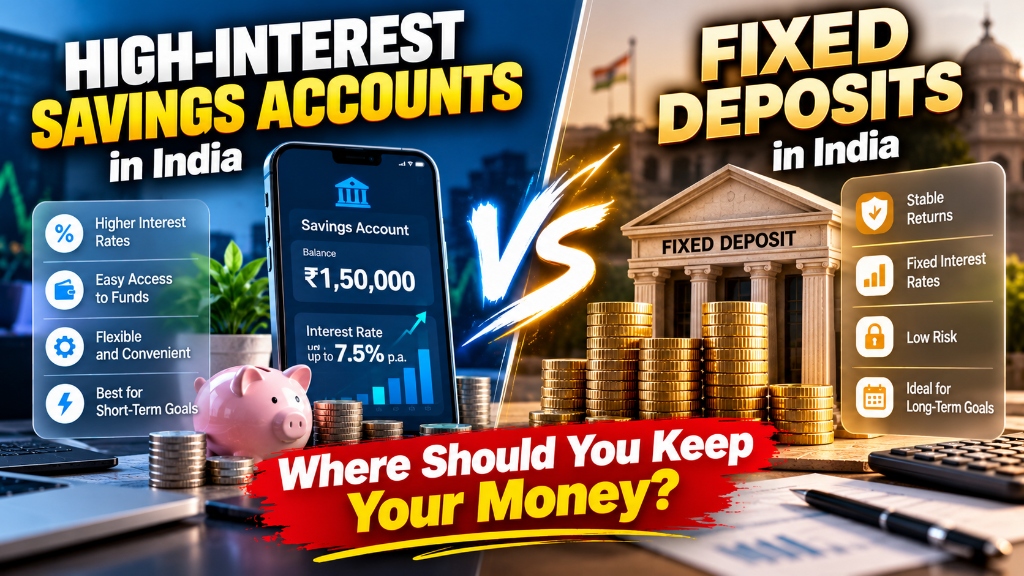
High-Interest Savings Accounts vs Fixed Deposits in India: Where Should You Keep Your Money?
Compare high-interest savings accounts vs fixed deposits in India for 2026. Review interest rates, DICGC insurance, tax rules, and emergency fund strategies.
Educational Resource: This guide does not constitute financial or legal counsel.
Deciding between a high-interest savings account and a fixed deposit in India comes down to liquidity versus guaranteed yields. High-interest savings accounts (paying 6.5% to 7.25%) offer instant liquidity for daily bills and emergency buffers, whereas fixed deposits (paying 7.0% to 8.5%) lock in returns for specific short-term goals.
Deciding where to park your hard-earned cash in India is no longer a simple choice between a low-yield savings account and a five-year fixed deposit.
The emergence of aggressive digital banking platforms and RBI-regulated Small Finance Banks (SFBs) has upended traditional retail banking. Today, select commercial lenders offer up to 7.25% interest on liquid savings balances, rivaling standard fixed deposit (FD) interest rates at traditional public-sector banks like SBI and PNB. At the same time, top fixed deposits and auto-sweep accounts offer guaranteed returns as high as 8.5% for select tenures.
However, chasing the highest headline interest rate without examining withdrawal penalties, Section 80TTA tax exemptions, TDS thresholds, and deposit insurance can cost you both returns and liquidity. This guide compares high-interest savings accounts against fixed deposits across all key financial dimensions in 2026.
What Is the Core Difference Between a Savings Account and a Fixed Deposit?
The core difference is that a savings account provides complete on-demand liquidity with fluctuating daily interest rates, while a fixed deposit locks in a guaranteed interest rate for a predetermined time period in exchange for premature withdrawal penalties.
In a savings account, money moves freely through UPI, debit cards, and ATM withdrawals without any friction or breakage fees. Interest is calculated on daily end-of-day balances and credited quarterly or monthly into your account.
In contrast, a fixed deposit (FD) is a term contract where you deposit a lump sum for a specific tenure (ranging from 7 days to 10 years). The bank guarantees your agreed interest rate for the entire duration, regardless of whether the Reserve Bank of India cuts benchmark repo rates tomorrow. If you withdraw the funds before maturity, the bank typically penalizes you by deducting 0.5% to 1.0% from the applicable interest rate.
Comprehensive Comparison: Savings Account vs Fixed Deposit in India (2026)
The table below compares regular savings accounts, high-yield digital accounts, scheduled commercial bank FDs, and Small Finance Bank FDs.
| Feature / Dimension | Standard Bank Savings Account | High-Interest Savings Account (IDFC, SFBs) | Top Commercial Bank FD (HDFC, ICICI, SBI) | Small Finance Bank FD (Equitas, AU, Ujjivan) | Auto-Sweep / Flexi-FD Facility |
|---|---|---|---|---|---|
| Typical Interest Rate (2026) | 2.75% to 3.50% | 6.00% to 7.25% (Tiered) | 6.80% to 7.40% | 7.75% to 8.50% | 6.50% to 7.10% |
| Liquidity & Access | Instant via UPI & ATM | Instant via UPI & ATM | Requires breaking deposit online | Requires breaking deposit online | Automated sweep to checking |
| Premature Exit Penalty | None | None | 0.5% to 1.0% interest reduction | 0.5% to 1.0% interest reduction | None on unswept amount |
| Tenure Lock-in | None (Indefinite) | None (Indefinite) | 7 days to 10 years | 7 days to 10 years | Dynamic threshold |
| Tax Exemption on Interest | Up to ₹10,000 under Sec 80TTA (Old regime) | Up to ₹10,000 under Sec 80TTA (Old regime) | No exemption under 80TTA (Sec 80TTB applies for seniors) | No exemption under 80TTA | Broken down between SB and FD portions |
| TDS (Tax Deducted at Source) | No TDS deducted by bank | No TDS deducted by bank | 10% TDS if interest > ₹40,000 (₹50k for seniors) | 10% TDS if interest > ₹40,000 | 10% TDS applied on FD component interest |
| DICGC Insurance Cover | Up to ₹5,00,000 per bank | Up to ₹5,00,000 per bank | Up to ₹5,00,000 per bank | Up to ₹5,00,000 per bank | Up to ₹5,00,000 per bank |
| Best For | Monthly spending buffer | Emergency fund liquidity | 1 to 3 year fixed milestones | Maximizing safe fixed yields | Maximizing lazy cash in current accounts |
High-Interest Savings Accounts: The Pros and Hidden Traps
High-interest savings accounts offered by institutions such as IDFC FIRST Bank, AU Small Finance Bank, and Equitas Small Finance Bank combine high interest rates with instant liquidity.
The Advantages of High-Yield Savings Accounts
- Immediate Zero-Penalty Access: Your money remains completely liquid. You can pay via UPI QR code or debit card at 2 AM on a Sunday without calculating premature breakage fees.
- Monthly Interest Compounding: Several new-age banks credit interest every thirty days rather than quarterly, allowing your interest payments to compound slightly faster over twelve months.
- Section 80TTA Tax Benefit: If you file your taxes under the Old Tax Regime, interest earned on savings bank accounts up to ₹10,000 per financial year is entirely tax-free under Section 80TTA of the Income Tax Act.
The Hidden Catches to Watch For
- Tiered Balance Requirements: Banks rarely pay 7% on your entire account balance. Instead, they use tiered structures: for example, 3% on the first ₹1,00,000, 5% on balances between ₹1 lakh and ₹5 lakh, and 7% only on the balance exceeding ₹5 lakh. Read the fine print to calculate your true effective blended yield.
- High Average Monthly Balance (AMB): Premium savings accounts paying higher rates often demand high minimum balances, ranging from ₹10,000 to ₹25,000, levying non-maintenance charges if your balance drops below the threshold.
- Variable Interest Rates: Savings account rates are not locked. The bank can cut its interest rate tomorrow without giving you prior personal notice.
Fixed Deposits: When Should You Lock Your Money?
Fixed deposits remain the best vehicle for locking in guaranteed interest rates before the central bank begins cutting rates.
The Advantages of Fixed Deposits
- Guaranteed Interest Lock-In: If you open a 3-year fixed deposit at 7.75%, your return is legally guaranteed for 36 months, even if market interest rates plummet to 5.0% next year.
- Psychological Barrier Against Impulse Spending: Because breaking an FD requires logging into your banking portal and consciously accepting a penalty, it acts as a healthy deterrent against emotional, non-essential spending.
- Special Senior Citizen Rates: Indian banks consistently offer senior citizens an additional 0.50% interest rate premium on domestic term deposits, with select lenders providing up to 0.75% extra on specialized tenures.
- Loan and Overdraft Facilities: You can take an instant digital overdraft or loan against your FD (up to 90% to 95% of the deposit value) at an interest rate just 1% to 2% above your FD rate, giving you access to cash without breaking your compounding maturity.
The Trade-Offs of Fixed Deposits
- Premature Withdrawal Penalties: Most banks deduct between 0.5% and 1.0% from the interest rate corresponding to the period the deposit actually ran if you withdraw early.
- TDS Deductions: If the cumulative interest from all your FDs with a single bank exceeds ₹40,000 in a financial year (₹50,000 for senior citizens), the bank automatically deducts 10% TDS, unless you submit Form 15G or Form 15H declaring zero taxable income.
Are Small Finance Banks Safe? The DICGC Guarantee Explained
Deposits in all RBI-scheduled banks, including Small Finance Banks, are insured up to ₹5,00,000 per depositor by the Deposit Insurance and Credit Guarantee Corporation (DICGC).
The DICGC is a wholly owned subsidiary of the Reserve Bank of India. Under current banking regulations, if a scheduled commercial bank or small finance bank were to fail, the DICGC legally guarantees reimbursement of both principal and accrued interest up to a maximum limit of ₹5,00,000 per customer, per bank.
To maximize your safety while harvesting higher 8.5% interest rates, you can implement the Bank Diversification Strategy: deposit ₹4.5 lakh each across three separate Small Finance Banks (such as AU Bank, Equitas, and Ujjivan). Each individual deposit remains 100% covered under the statutory DICGC safety net, giving you higher overall interest while maintaining total insurance protection.
How to Choose: Where Should You Put Your Money?
To determine where to park your capital, categorize your funds by time horizon and intended purpose.
- Daily Operational Expenses (0 to 30 days): Keep this money in your primary Standard Savings Account. This covers rent, grocery delivery, utility bills, and daily UPI payments.
- Emergency Fund (3 to 6 months of living expenses): Split this capital 50/50 between a High-Interest Savings Account (for instant cash access) and a Liquid Mutual Fund or Sweep-in FD. Review our complete guide on building a bulletproof emergency fund in volatile markets for exact allocation ratios.
- Specific Milestones (6 months to 3 years): Lock this money into a Bank Fixed Deposit. If you are saving for a wedding, a car down payment, or an overseas vacation scheduled within twenty-four months, an FD protects your principal from equity market drawdowns while earning guaranteed yield.
- Long-Term Wealth Building (5+ years): Avoid keeping excessive capital in either savings accounts or FDs, because after paying income taxes and factoring in retail inflation, fixed-interest products offer nearly zero real purchasing-power growth. Redirect surplus capital into disciplined mutual fund SIPs.
Frequently Asked Questions
Which bank offers the highest savings account interest rate in India in 2026?
Select Small Finance Banks like Equitas, AU Small Finance Bank, and private lenders like IDFC FIRST Bank offer the highest savings interest rates, reaching up to 7.0% to 7.25% on specific tiered balances.
Is interest from fixed deposits tax-free?
No, fixed deposit interest is fully taxable and is added directly to your gross total income, taxed at your marginal income tax slab rate under both the Old and New Tax Regimes.
What is the maximum insurance limit on bank deposits in India?
The Deposit Insurance and Credit Guarantee Corporation (DICGC) insures deposits, including savings, current, and fixed deposits, up to a maximum of ₹5,00,000 per depositor per bank.
Does a Sweep-in fixed deposit affect liquidity?
No, a Sweep-in or Multi-Option Deposit (MOD) maintains full liquidity by automatically breaking only the exact amount needed when your checking balance falls short of a withdrawal, leaving the remaining funds to earn higher FD interest.
Can I avoid TDS on my fixed deposit interest?
You can avoid TDS by submitting Form 15G (for individuals below 60) or Form 15H (for senior citizens) at the beginning of each financial year, provided your total taxable income falls below the basic exemption limit.
Strategic Takeaway and Action Plan
Never leave large sums of idle cash sitting in a traditional savings account earning a meager 2.75% interest.
Take thirty minutes this week to audit your cash holdings. Keep one month of living expenses in your operational checking account, calculate your exact liquid buffer with our free Emergency Fund Calculator, move your emergency reserves into a high-interest savings account or sweep-in facility earning 6.5% to 7.25%, and lock short-term goal savings into guaranteed FDs.
If you are deciding between market growth and safe fixed rates for longer horizons, explore our in-depth SIP vs Fixed Deposit Comparison. For funds you will not need for the next five to ten years, transition that money into wealth compounding assets using our detailed guide on how to start a SIP in India.
Download: The 2026 Wealth Compounding & FIRE Planning Toolkit
Our complete spreadsheet model and 28-page strategic handbook covering asset allocation buckets, Indian inflation adjustments, and long-term SIP compounding.
- Interactive FIRE & Net Worth Excel/Sheets model
- Asset allocation & emergency reserve matrix
This article and its associated calculators are for educational and informational purposes only and do not constitute financial, investment, legal, tax, or medical advice. We may earn an affiliate commission on third-party links at zero cost to you. Always consult a licensed professional before making major financial, health, or investment decisions. Read our full Legal & Financial Disclaimer.
Aditya Singhania
Verified AuthorAditya writes about investing, saving habits, and smart money management. With a background in financial planning, he helps readers build simple, reliable wealth habits for the long run.
Was this essay valuable to you?
Help us refine our editorial focus and research priorities.
Reader Discussion (2)
Extremely well-articulated analysis on capital compounding. The breakdown on equity allocation vs active income is spot on.
The distinction between looking rich and building real moats is something more founders need to study deeply.
Explore Eternity Empire
Search empirical insights, explore our four wisdom categories, and discover curated strategic essays.
Search Insights
Recent Essays
The Backyard Cash Flow Engine: How to House Hack with an ADU in 2026
11 min read • Oct 20How to Become a Fractional COO: Landing Your First $5,000/Month Retainer Client
12 min read • Oct 20The Zero-Bounce Outbound Engine: How to Set Up Multi-Domain Cold Email with Instantly and Clay
12 min read • Oct 20Featured Guides
Further Wisdom & Insights
Explore All Articles
Apple Pay India Launch: How to Set It Up, Where It Works, and What's Missing (2026)
Apple Pay is now live in India with Axis Bank. See how to set it up, which cards work, where to use it, and why UPI is not included yet.

Mortgage Recast vs. Refinance: How to Cut Your Monthly House Payment Without Losing Your Low Rate
Compare mortgage recast vs refinance calculator math. Learn how to lower monthly house payments for $300 without giving up your 3% fixed mortgage interest rate.

Index Fund Investing for Beginners: The 3-Fund Portfolio (2026)
Master index fund investing with the simple 3-fund portfolio in 2026. Learn exact Vanguard, Fidelity, and Schwab tickers, age allocations, and tax placement.