

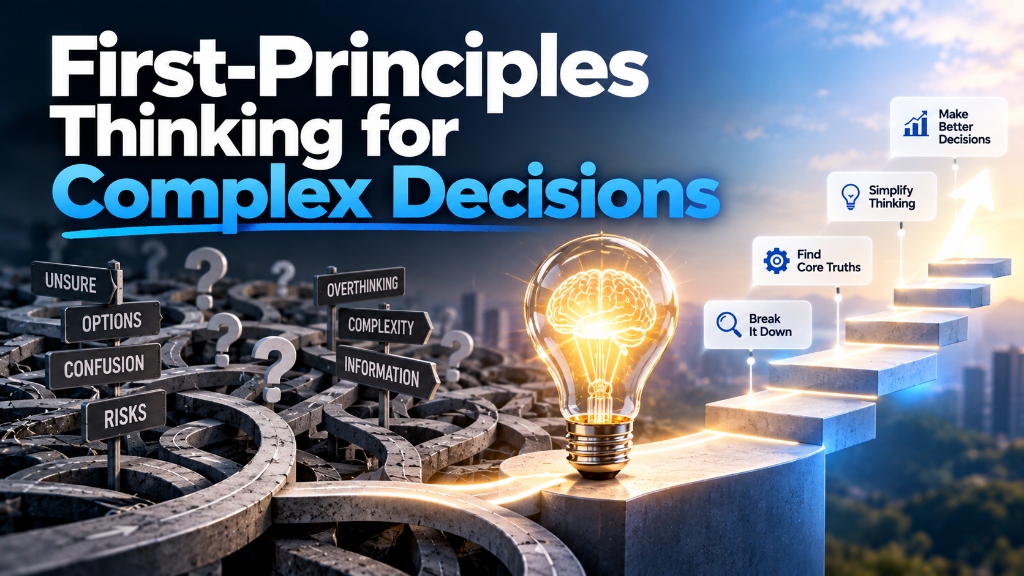
First-Principles Thinking for Complex Decisions
Deconstructing assumptions to fundamental truths to make high-stakes strategic choices under uncertainty.
Disclaimer: This article is for educational purposes only and does not constitute financial or legal advice. We may earn an affiliate commission on links at no cost to you.
Read full disclaimer ↓Listen to "First-Principles Thinking for Complex Decisions"
Natural Voice Synthesis • Hands-free listening
First-principles thinking is a mental framework where you break down complex problems into fundamental, non-negotiable truths and build solutions up from scratch. Instead of copying existing solutions through conventional analogy, reasoning from first principles eliminates industry consensus assumptions to reveal non-obvious strategic advantages.
First-principles thinking deconstructs problems into foundational facts, stripping away industry convention and cognitive bias. By rebuilding solutions from core physics and empirical data rather than analogy, decision-makers unlock breakthrough innovations and avoid costly consensus mistakes. Begin by listing every baseline assumption in your current strategic problem and challenging its empirical validity.
what’s first-Principles Thinking?
First-principles thinking is a philosophical and scientific decision technique originally articulated by Aristotle and utilized by top innovators to bypass legacy assumptions. Most human reasoning relies on analogy: imitating what others have done with minor incremental tweaks. Reasoning from first principles forces you to boil a problem down to its most fundamental truths and reason up from there.
Reasoning by Analogy vs. Reasoning by First Principles
Understanding the distinction between conventional reasoning and first-principles analysis is crucial for strategic problem solving.
- Reasoning by Analogy: Copying existing operational methods with minor modifications. For example, designing a new battery pack by looking at existing market prices and assuming cost structures will remain static.
- Reasoning by First Principles: Deconstructing the product to basic material components. For example, calculating the raw spot market cost of lithium, cobalt, nickel, and carbon, and determining how to synthesize them at a fraction of current market rates.
Reasoning by analogy creates linear iterations. Reasoning by first principles creates model shifts.
The 3-Step First-Principles Framework
You can apply first-principles reasoning to any strategic business or personal decision using this structured process.
- Identify and Explicitly Define Assumptions: Write down every assumption currently accepted as standard truth in your domain.
- Deconstruct Assumptions Down to Foundational Truths: Challenge each assumption by asking Socratic questions until you reach verifiable, empirical data points that can’t be broken down further.
- Rebuild New Solutions From Ground Zero: Construct novel strategies using only the validated core components, ignoring how the problem was historically approached.
Practical example: Rocket Manufacturing Cost Reduction
Consider the historical cost of space travel:
Legacy aerospace defense contractors assumed satellite launching must cost over $100 million per rocket because historically manufactured components were specialized and expensive (reasoning by analogy).
By applying first-principles thinking, engineers evaluated the raw material costs of aerospace-grade aluminum alloys, titanium, copper, and carbon fiber on the open commodity market. They discovered that raw materials accounted for only 2% of total rocket build costs. By manufacturing components in-house and engineering reusable first-stage boosters, launch costs were reduced by over 80%.
Comparison: Mental Decision Frameworks
| Decision Framework | Primary Focus | Best Use Case | Main Advantage | Potential Limitation |
|---|---|---|---|---|
| First-Principles Thinking | Fundamental physics & data | Breakthrough innovation, cost reduction | Eliminates consensus bias | High cognitive effort |
| Inversion Framework | Avoiding catastrophic failure | Risk management, safety protocol | Highlights hidden liabilities | doesn’t generate new growth |
| Mental Model Analogy | Historical pattern matching | Fast routine operational choices | High execution speed | Reinforces outdated defaults |
| Second-Order Thinking | Long-term ripple effects | Policy and structural shifts | Prevents unintended consequences | Can cause paralysis by analysis |
Common pitfalls and Strategic Limitations
First-principles thinking requires significant cognitive energy and isn’t necessary for every routine daily choice.
- Cognitive Overload: Attempting to deconstruct every mundane daily decision creates unnecessary friction and fatigue.
- Ignoring Valid Heuristics: Established industry conventions exist for good reasons, such as safety standards or regulatory compliance; ignoring them completely can introduce severe compliance risk.
- Data Insufficiency: First principles require accurate foundational facts. If your baseline data is flawed, your rebuilt solution will also fail.
Frequently asked questions
When should I use first-principles thinking over reasoning by analogy?
Use first-principles thinking for high-stakes, novel, or high-cost problems where conventional methods produce mediocre results. Use reasoning by analogy for low-stakes, routine administrative tasks where speed is more valuable than breakthrough innovation.
How does first-principles thinking help eliminate bias?
It eliminates bias by requiring empirical proof for every underlying assumption, forcing decision-makers to discard emotional attachments or tradition-based arguments.
Can first-principles thinking be applied to personal finances?
Yes. Rather than following generic budgeting rules, you break your financial system down to income, fixed essential survival costs, and compound asset generation to build a custom financial engine.
Strategic recommendation
apply first-principles thinking to your most critical strategic bottleneck this week. Strip away what industry peers are doing and reconstruct your plan based strictly on empirical facts and non-negotiable goals.
Download: The Capital Allocation & Wealth Framework PDF
Get our comprehensive 30-page strategic PDF guide covering asset allocation, business moats, and mental models for long-term compounding.
- High-margin enterprise checklist
- Asset allocation proportion matrix
This article and its associated calculators are for educational and informational purposes only and do not constitute financial, investment, legal, tax, or medical advice. We may earn an affiliate commission on third-party links at zero cost to you. Always consult a licensed professional before making major financial, health, or investment decisions. Read our full Legal & Financial Disclaimer.
Written by Eternity Empire Editorial Team
The Eternity Empire editorial team analyzes personal finance, capital allocation, business strategy, and long-term wealth preservation frameworks.
Was this essay valuable to you?
Help us refine our editorial focus and research priorities.
Reader Discussion (2)
Extremely well-articulated analysis on capital compounding. The breakdown on equity allocation vs active income is spot on.
The distinction between looking rich and building real moats is something more founders need to study deeply.
Explore Eternity Empire
Search insights, browse categories, and discover featured publication guides.
Search Insights
Recent Insights
Further Wisdom & Insights
Explore All Articles →
The Psychology of Long-Term Thinking in a Distracted World
How high performers resist short-term dopamine loops, optimize for second-order consequences, and build compound advantages over 10-year horizons.

The Operating System for Delegating Key Business Tasks
How entrepreneurs delegate operational tasks effectively using outcome-based accountability, SOP documentation, and async workflows.

The Micro-SaaS Playbook: Building Profitable Niche Software
How solo developers and small teams build, launch, and scale high-margin niche software products to $10k+ recurring monthly revenue.