

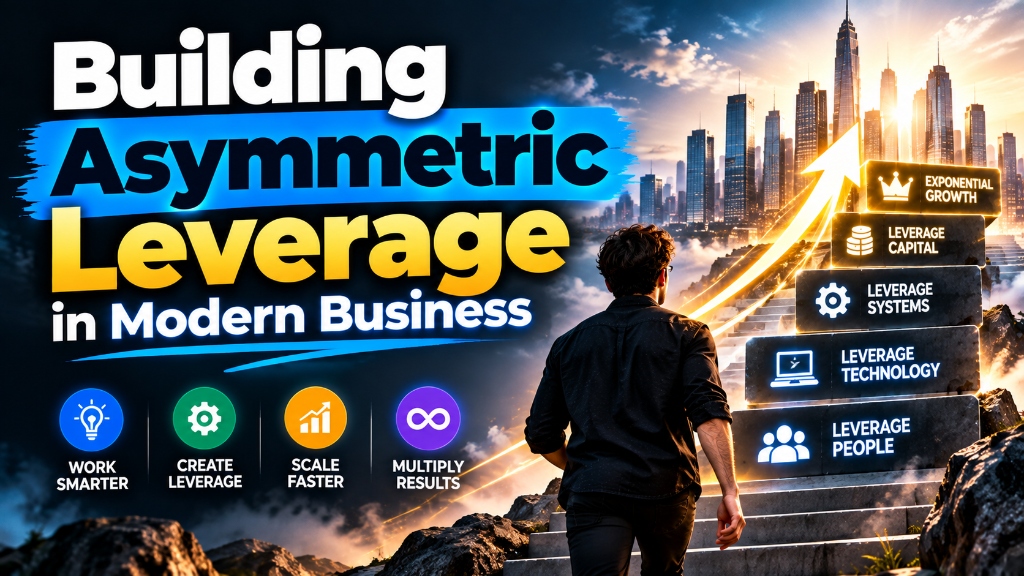
Building Asymmetric Leverage in Modern Business
Why modern enterprises scale through code, capital, media, and zero-marginal-cost distribution mechanisms.
Disclaimer: This article is for educational purposes only and does not constitute financial or legal advice. We may earn an affiliate commission on links at no cost to you.
Read full disclaimer ↓Listen to "Building Asymmetric Leverage in Modern Business"
Natural Voice Synthesis • Hands-free listening
Building asymmetric advantage in modern business means using permissionless instruments like code and digital media to decouple income from direct labor hours. Rather than scaling revenue linearly by adding expensive payroll, high-performing founders engineer software systems and digital content that replicate infinitely at near-zero marginal cost.
Asymmetric advantage allows modern enterprise teams to generate exponential output without linear cost increases. By prioritizing permissionless advantage (code and media) over permissioned advantage (labor and capital), founders reduce marginal unit costs, improve profit margins, and build durable competitive moats. Start by automating one repetitive operational workflow using software or self-serve documentation.
what’s asymmetric advantage in Business?
Asymmetric advantage is an operational structure where potential financial upside exponentially exceeds input time and marginal cost. In traditional industrial models, business expansion required hiring additional workers or purchasing physical machinery. In modern digital markets, software algorithms and digital media assets deliver services millions of times simultaneously without requiring incremental operational overhead.
The four pillars of Modern Enterprise Leverage
Enterprise advantage can be organized into four distinct categories, divided into permissioned advantage (requiring external approval or capital) and permissionless advantage (accessible to anyone with technical skill).
- Labor Leverage: Managing human workforce and delegation. While effective, labor requires active management, equity alignment, and high organizational complexity.
- Capital Leverage: Deploying financial capital. Investing in automation tooling, acquisition pipelines, and strategic assets multiplies executive decision making.
- Code Leverage: Automated software algorithms operating 24 hours a day at zero marginal cost. Code is permissionless advantage because anyone can write software without requiring permission from traditional gatekeepers.
- Media and Content Leverage: Digital content, documentation, and media assets that communicate with global audiences simultaneously. Media acts as a 24/7 sales representative that never sleeps or requests salary increases.
Permissionless advantage allows small technical teams to achieve enterprise outputs historically requiring hundreds of full-time employees.
How to Implement Code and Media Leverage in 4 Steps
Implementing advantage requires systematically identifying manual operational bottlenecks and replacing them with reproducible digital architecture.
- Audit Operations for Repeatable Tasks: Track company time across customer onboarding, lead qualifying, reporting, and fulfillment to identify manual patterns.
- Standardize Manual Protocols: Document exact step-by-step instructions for every process before attempting automation or software implementation.
- Deploy Code Automation: Integrate APIs, webhooks, and custom scripts to eliminate repetitive manual data movement across operational platforms.
- Publish Asymmetric Media Assets: Convert internal knowledge into publicly accessible guides, video tutorials, and technical documentations that answer customer questions asynchronously.
Practical example: Operational Scaling Comparison
Consider two consulting firms handling client acquisition and onboarding:
Firm A operates traditionally with five full-time account executives manually scheduling discovery calls, drafting proposals, and onboarding clients. Their monthly capacity caps out at 20 new clients with overhead costs scaling linearly.
Firm B builds an automated self-serve platform with interactive video demonstrations, dynamic instant pricing calculators, and automated contract workflows. Firm B handles 200 new clients monthly with zero incremental account executive salary costs, achieving an 82% gross margin compared to Firm A’s 28% margin.
Strategic comparison: The 4 Types of Leverage
| Leverage Type | Best For | Main Advantages | Key Limitations | Capital / Resource Impact |
|---|---|---|---|---|
| Labor | Complex operational tasks | High adaptability, human empathy | High payroll cost, management friction | High ongoing expense |
| Capital | Rapid asset acquisition | Rapid expansion capacity | Requires existing capital reserves | High risk exposure |
| Code | Scalable digital workflows | Zero marginal cost, 24/7 reliability | Requires engineering capability | High upfront dev cost |
| Media | Audience and brand building | Infinite distribution, high trust | Requires consistent quality output | Low capital, high time |
Limitations and Risks of Unchecked Leverage
While advantage magnifies positive business decisions, it equally magnifies operational errors and strategic mistakes.
- Magnified Flaws: Automated software or mass media distribution will scale broken processes faster than manual operations can resolve them.
- Over-Engineering: Implementing complex software workflows for unverified business ideas wastes valuable capital and focus.
- Loss of Personal Touch: Excessively automated customer interactions can diminish brand loyalty if client support becomes robotic or inaccessible.
Frequently asked questions
Which type of advantage should a early-stage business start with?
Early-stage businesses should start with media and basic code advantage because both are permissionless and require minimal upfront capital. Creating educational media builds initial audience trust while basic software integrations reduce administrative distraction.
Why is code considered the highest-advantage asset?
Code is considered the highest-advantage asset because once written, it executes complex logic repeatedly across the globe at near-zero marginal cost without fatigue.
what’s the difference between permissioned and permissionless advantage?
Permissioned advantage (labor and capital) requires third-party approval such as investors or job candidates, whereas permissionless advantage (code and media) only requires personal effort and internet access.
Strategic recommendation
prioritize building permissionless software and media assets over hiring large operational teams. Focus initial efforts on automating one high-volume customer process to reclaim bandwidth for high-advantage strategic decisions.
Download: The Capital Allocation & Wealth Framework PDF
Get our comprehensive 30-page strategic PDF guide covering asset allocation, business moats, and mental models for long-term compounding.
- High-margin enterprise checklist
- Asset allocation proportion matrix
This article and its associated calculators are for educational and informational purposes only and do not constitute financial, investment, legal, tax, or medical advice. We may earn an affiliate commission on third-party links at zero cost to you. Always consult a licensed professional before making major financial, health, or investment decisions. Read our full Legal & Financial Disclaimer.
Written by Eternity Empire Editorial Team
The Eternity Empire editorial team analyzes personal finance, capital allocation, business strategy, and long-term wealth preservation frameworks.
Was this essay valuable to you?
Help us refine our editorial focus and research priorities.
Reader Discussion (2)
Extremely well-articulated analysis on capital compounding. The breakdown on equity allocation vs active income is spot on.
The distinction between looking rich and building real moats is something more founders need to study deeply.
Explore Eternity Empire
Search insights, browse categories, and discover featured publication guides.
Search Insights
Recent Insights
Further Wisdom & Insights
Explore All Articles →
The Psychology of Long-Term Thinking in a Distracted World
How high performers resist short-term dopamine loops, optimize for second-order consequences, and build compound advantages over 10-year horizons.
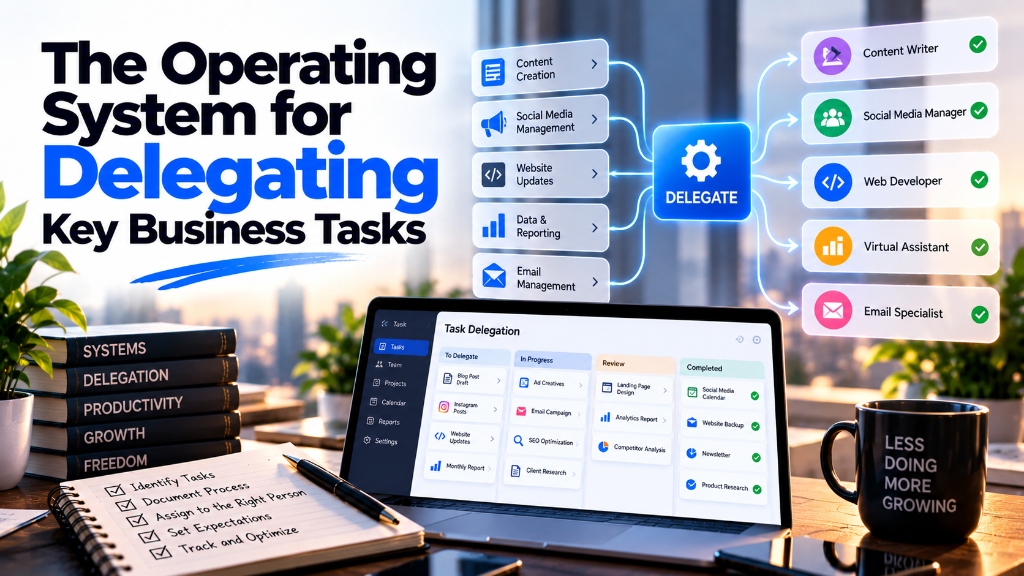
The Operating System for Delegating Key Business Tasks
How entrepreneurs delegate operational tasks effectively using outcome-based accountability, SOP documentation, and async workflows.
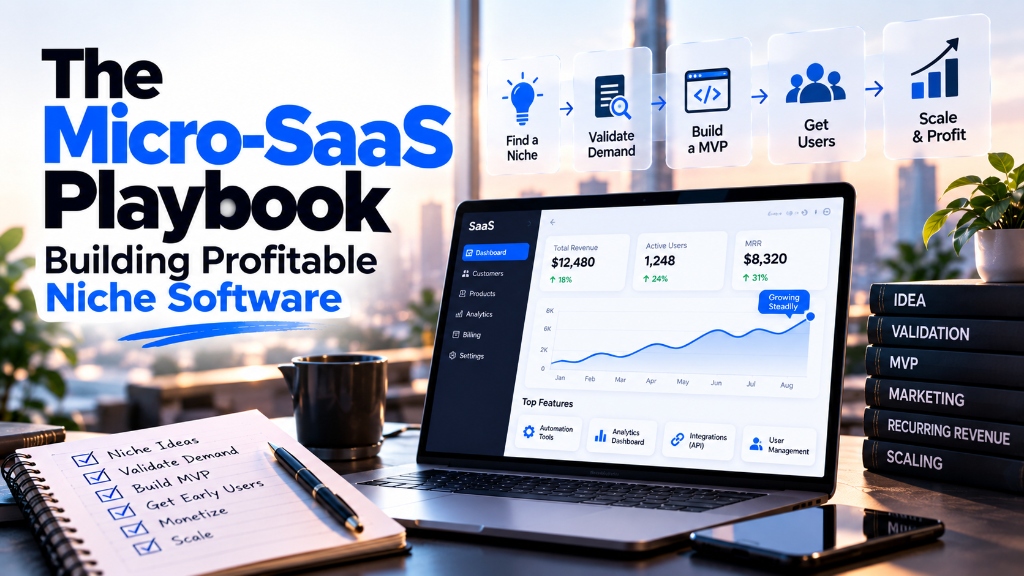
The Micro-SaaS Playbook: Building Profitable Niche Software
How solo developers and small teams build, launch, and scale high-margin niche software products to $10k+ recurring monthly revenue.