

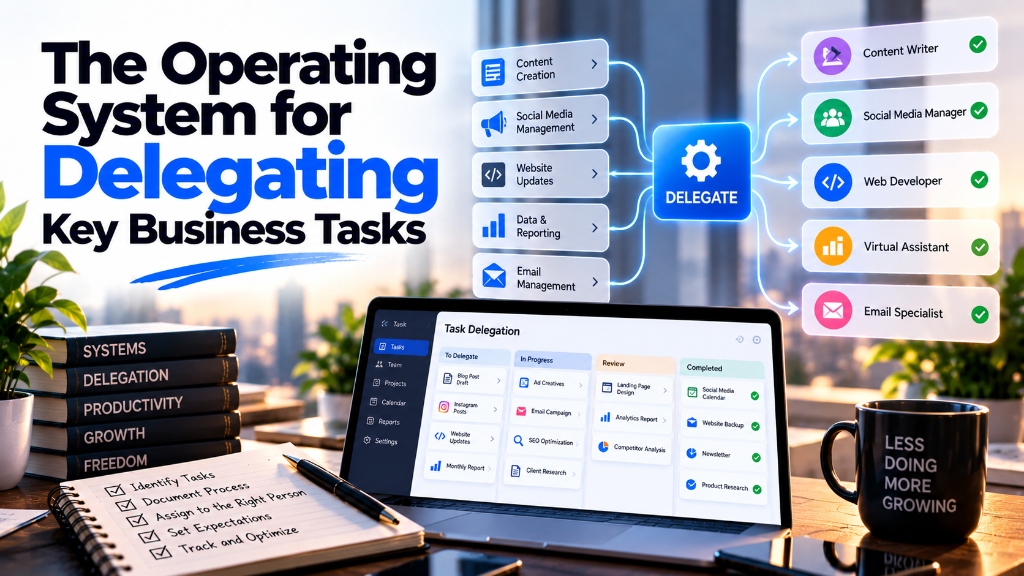
The Operating System for Delegating Key Business Tasks
How entrepreneurs delegate operational tasks effectively using outcome-based accountability, SOP documentation, and async workflows.
Disclaimer: This article is for educational purposes only and does not constitute financial or legal advice. We may earn an affiliate commission on links at no cost to you.
Read full disclaimer ↓Listen to "The Operating System for Delegating Key Business Tasks"
Natural Voice Synthesis • Hands-free listening
Delegating key business tasks requires shifting from micromanaging step-by-step activity to assigning outcome-based accountability supported by clear Standard Operating Procedures (SOPs). Founders who fail to build delegation systems become operational bottlenecks, trapping themselves in daily execution rather than strategic growth.
Effective task delegation is the process of transferring operational decision authority to team members using structured SOPs and defined outcome criteria. Build a scalable delegation operating system by defining the expected end result, recording asynchronous video walkthroughs, establishing clear financial sign-off thresholds, and reviewing deliverables asynchronously.
The founder trap: Micromanagement vs Abdication
Most business founders struggle with delegation because they fall into one of two toxic extremes:
- Micromanagement: Dictating every mouse click, holding daily status calls, and redoing completed work because it was not executed identically to how the founder would do it.
- Operational Abdication: Dumping complex responsibilities onto contractors or employees without guidelines, context, or clear success criteria, then acting surprised when execution fails.
True delegation operates in the middle: providing explicit definitions of done while giving team members autonomy over execution choices.
The 4 Levels of Delegation Authority
To prevent operational confusion, assign an explicit authority level to every delegated responsibility.
Level 1: Research & Report (Gather information, bring to founder for decision)
Level 2: Recommend & Wait (Propose solution, wait for founder sign-off before executing)
Level 3: Execute & Inform  (Take action immediately, inform founder in weekly digest)
Level 4: Full Ownership   (Complete autonomous control, no founder updates required)
Strategic comparison: Delegation Systems
| Method | Setup Effort | Operational Scalability | Error Rate | Best Applied To |
|---|---|---|---|---|
| Verbal Instructions | Very Low | Zero (Requires constant re-explanation) | High | One-off emergency tasks |
| Live 1-on-1 Training | High | Low (Tied to real-time calendars) | Moderate | Complex executive onboarding |
| Written & Video SOP Library | Moderate | High (Infinite async playback) | Low | Standard operational workflows |
| Autonomous Outcome Contracts | Low (Post-SOP) | Maximum (Self-managing team) | Very Low | Core business functions |
How to Build a Delegation Operating System in 4 Steps
Constructing a self-serve delegation system frees up 15+ hours of executive bandwidth per week.
- Record Workflows Asynchronously: Whenever performing a routine business task, record your screen using video tools like Loom while speaking your thought process aloud.
- Structure a 1-Page Written SOP: Convert the recording into a structured document containing: Purpose, Prerequisites, Step-by-Step Instructions, and Definition of Done.
- Set Clear Financial Sign-Off Thresholds: Authorize team members to spend up to $250 or $500 independently to resolve customer problems without seeking founder approval.
- Shift to Asynchronous Weekly Audits: Replace daily status meetings with a single Friday async report where team members post completed metrics, key blockers, and next week’s priorities.
Real world case example: Customer Support Delegation
Consider an e-commerce software founder spending three hours daily answering 40 customer support tickets regarding billing refunds and password resets.
The founder records five screen capture videos covering the top recurring ticket scenarios and writes a 2-page SOP titled “Customer Refund Protocol”.
The founder hires a remote customer specialist and sets clear authority levels: Level 3 for refunds under $100 (issue refund instantly and log in weekly sheet) and Level 2 for refunds over $100 (propose resolution for founder Slack sign-off).
Within one week, the founder’s support workload drops from 21 hours weekly to 30 minutes of Friday review time, freeing up 20+ hours for product development.
Frequently asked questions
How do I know if a task should be automated, delegated, or eliminated?
Apply the Rule of Three: If a task can be deleted without harming customer experience, eliminate it. If a task is repetitive and predictable, automate it with software. If a task requires human judgment, delegate it with an SOP.
What should I do if a team member makes a mistake on a delegated task?
When a mistake occurs, audit the SOP rather than blaming the person. Ask whether the instructions were ambiguous, if prerequisites were missing, or if authority levels were unclear. Update the SOP immediately to prevent the error from repeating.
How often should SOP documents be updated?
SOP documents should be updated whenever software tools change or at least once per year. Empower the team member executing the role to update and improve the SOP directly as they find more efficient workflows.
Download: The Capital Allocation & Wealth Framework PDF
Get our comprehensive 30-page strategic PDF guide covering asset allocation, business moats, and mental models for long-term compounding.
- High-margin enterprise checklist
- Asset allocation proportion matrix
This article and its associated calculators are for educational and informational purposes only and do not constitute financial, investment, legal, tax, or medical advice. We may earn an affiliate commission on third-party links at zero cost to you. Always consult a licensed professional before making major financial, health, or investment decisions. Read our full Legal & Financial Disclaimer.
Written by Eternity Empire Editorial Team
The Eternity Empire editorial team analyzes personal finance, capital allocation, business strategy, and long-term wealth preservation frameworks.
Was this essay valuable to you?
Help us refine our editorial focus and research priorities.
Reader Discussion (2)
Extremely well-articulated analysis on capital compounding. The breakdown on equity allocation vs active income is spot on.
The distinction between looking rich and building real moats is something more founders need to study deeply.
Explore Eternity Empire
Search insights, browse categories, and discover featured publication guides.
Search Insights
Recent Insights
Further Wisdom & Insights
Explore All Articles →
The Psychology of Long-Term Thinking in a Distracted World
How high performers resist short-term dopamine loops, optimize for second-order consequences, and build compound advantages over 10-year horizons.

The Micro-SaaS Playbook: Building Profitable Niche Software
How solo developers and small teams build, launch, and scale high-margin niche software products to $10k+ recurring monthly revenue.

The Art of Saying No: Protecting Your Highest-Leverage Time
How top executives decline low-value commitments, set strict calendar boundaries, and protect focus time for high-advantage business activities.