

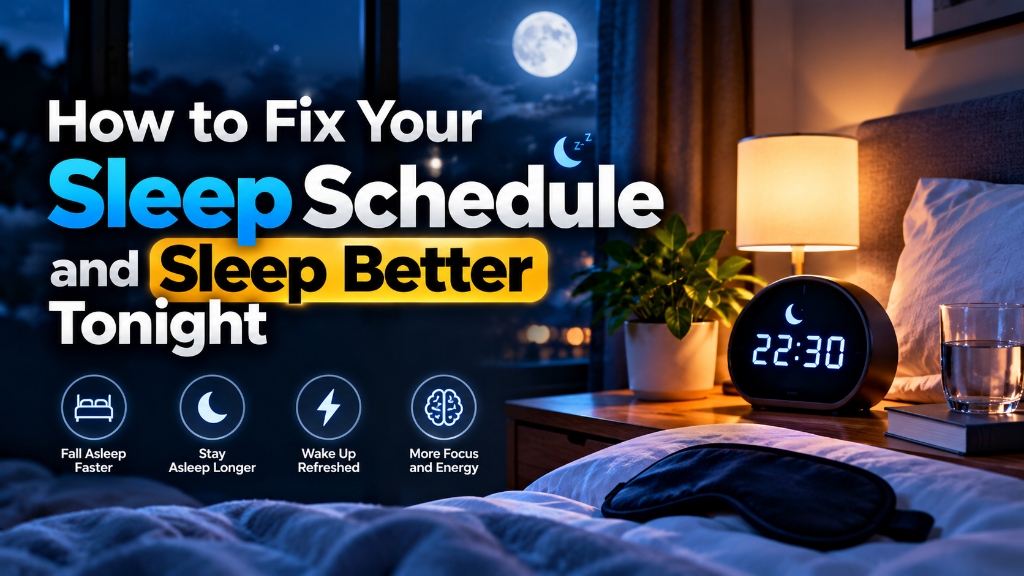
How to Fix Your Sleep Schedule and Sleep Better Tonight
Learn how to fall asleep fast, stop 3 a.m. wake-ups, reset your sleep schedule, and pay off sleep debt with simple, science-backed habits.
Disclaimer: This article is for educational purposes only and does not constitute financial or legal advice. We may earn an affiliate commission on links at no cost to you.
Read full disclaimer ↓Listen to "How to Fix Your Sleep Schedule and Sleep Better Tonight"
Natural Voice Synthesis • Hands-free listening
Struggling with erratic sleep patterns, late-night insomnia, or mid-night awakenings affects energy, focus, and long-term health. Restoring a healthy sleep cycle requires adjusting key daily habits, morning light exposure, and bedroom environment.
To fix your sleep schedule, wake up at the exact same time every day, get bright daylight within an hour of waking, and keep your bedroom dark and cool (60 to 67°F). Shift your bedtime by 15 to 30 minutes at a time rather than all at once. Skip long weekend sleep-ins to protect your circadian rhythm.
The Quick Answer
To fix your sleep schedule, wake up at the exact same time every day, get bright daylight within an hour of waking, and keep your bedroom dark, quiet, and cool. Shift your bedtime by 15 to 30 minutes at a time rather than all at once. Skip long weekend sleep-ins. Most adults need at least seven hours of sleep, and recovering from lost sleep takes several days of consistent rest.
Below is the complete operational guide for falling asleep fast, staying asleep through the night, resetting your body clock, and optimizing sleep during exams, night shifts, and travel.
How Does Sleep Actually Work?
Sleep is regulated by two primary mechanisms: internal sleep pressure and your circadian rhythm.
Sleep Pressure
Sleep pressure accumulates continuously the longer you stay awake. Think of it as a biological tank that fills during waking hours and drains while you sleep. The chemical adenosine builds up in your brain during awake hours, creating heavy tiredness.
Your Circadian Rhythm
Your body clock (the circadian rhythm) dictates when you feel naturally alert or sleepy across a 24-hour cycle. Daylight is its primary environmental signal: morning light signals your brain to release cortisol for alertness, while evening darkness triggers natural melatonin production.
Most sleep difficulties occur when sleep pressure is insufficient at bedtime or when your internal circadian clock drifts out of alignment with your schedule.
Sleep Cycles
Your nightly sleep is divided into cycles lasting roughly 90 minutes. Most adults complete four to six cycles per night, transitioning between light sleep, deep slow-wave sleep, and REM (Rapid Eye Movement) sleep. You briefly wake up between cycles, though you rarely remember these micro-awakenings unless stress or noise keeps you awake.
Most adults require at least seven to nine hours of quality sleep per night for optimal cognitive and physical performance.
Sleep Hygiene Checklist for Better Sleep
Sleep hygiene represents the foundational daily habits and environmental controls that prepare your brain for restorative rest. Use this practical checklist to audit your daily habits.
Timing & Schedule
- Fixed Alarm: Wake up at the same time every day, including weekends.
- Morning Sunlight: Step outside into natural daylight within 60 minutes of waking.
- Strategic Napping: Limit naps to 20 minutes maximum and finish them before 3 p.m.
Evening Wind-Down
- Caffeine Cutoff: Stop consuming caffeine at least 8 hours before bedtime.
- Alcohol Limitation: Avoid alcohol close to bedtime; while it induces drowsiness, it disrupts second-half sleep architecture.
- Meal Timing: Finish large dinners 2 to 3 hours before sleep to prevent acid reflux.
- Lighting Control: Dim overhead lights 60 minutes before bed.
- Screen Curfew: Turn off phones, tablets, and TV screens 30 to 60 minutes before sleep.
- Brain Dump: Write down tomorrow’s task list to offload cognitive anxiety.
Bedroom Environment
- Dark, Quiet, & Cool: Maintain room temperature around 60 to 67°F (15 to 19°C).
- Bed Association: Reserve your bed exclusively for sleep and intimacy, not for work or social media scrolling.
- Phone Placement: Charge your mobile device across the room or outside the bedroom.
How to Fall Asleep Fast Naturally
Falling asleep fast requires lowering your core body temperature and shifting your autonomic nervous system from high alertness into relaxation. While no single method guarantees 5-minute sleep every time, these evidence-backed protocols significantly accelerate sleep onset.
1. Cool the Room
Cooling your bedroom to 60-67°F (15-19°C) triggers the natural drop in core body temperature required to initiate sleep. Keep the room dark and quiet to support melatonin production.
2. Try 4-7-8 Breathing
The 4-7-8 breathing technique calms your nervous system by extending your exhale and lowering your heart rate. Inhale through your nose for 4 seconds, hold for 7 seconds, and exhale slowly through your mouth for 8 seconds. Repeat four full cycles.
3. Do a Slow Body Scan
Progressive muscle relaxation releases physical tension across your body to signal safety to your brain. Tense your toes for 5 seconds, release, and move slowly upward through your calves, thighs, stomach, shoulders, and face.
4. Warm Up, Then Cool Down
Taking a warm bath or shower 60 to 90 minutes before bed accelerates core cooling once you step out. The rapid thermal drop after stepping out nudges your body toward sleepiness.
5. Use the 20-Minute Rule
Getting out of bed after 20 minutes of wakefulness prevents your brain from linking your bed with frustration. Sit in a dimly lit room and read a physical book until you feel sleepy, then return to bed.
How to Fall Asleep When Your Mind Is Racing
Calming a racing mind requires offloading intrusive thoughts onto paper and refocusing cognitive energy onto dull, repetitive mental tasks.
- Brain Dump: Spend five minutes writing every open task or worry into a paper notebook, then close it.
- Boring Mental Imagery: Visualize walking slowly through a familiar, unexciting environment in vivid detail.
- Backward Counting: Count backward from 300 by threes. It absorbs cognitive focus without creating emotional arousal.
- Cognitive Decoupling: Remind yourself that quiet rest in bed provides substantial physical recovery even if you are not fully asleep.
How to Stop Waking Up at 3 a.m. Every Night
Waking up around 3 a.m. occurs when your sleep pressure drops, lighter REM sleep dominates, and early morning cortisol levels begin to rise.
Why 3 a.m.?
Mid-night awakenings at 3 a.m. happen because deep sleep pressure is mostly depleted during the first third of the night. As the night progresses, your body transitions into lighter REM-heavy cycles. Rising stress hormones, late alcohol consumption, heavy meals, or temperature spikes can easily trigger full awakenings during these lighter phases.
What to Do Tonight
- Never Check the Clock: Looking at the time activates stress calculations and raises your heart rate. Turn clocks away from your sightline.
- Keep Lights Low: Avoid turning on bright overhead lights or looking at smartphone screens.
- Apply the 20-Minute Rule: If awake for more than 20 minutes, move to a comfortable chair in dim light until sleepiness returns.
- Eliminate Nighttime Liquids: Stop drinking fluids 2 hours before bed to reduce nocturnal bathroom trips.
- Anchor Your Wake Alarm: Keep your morning wake-up time identical regardless of how many times you woke up during the night.
When 3 a.m. Waking Needs a Doctor
You should see a doctor for 3 a.m. awakenings if you gasp for air, snore loudly, wake up to urinate multiple times per night, or experience chronic daytime fatigue. Sleep apnea, restless legs syndrome, and acid reflux are highly treatable medical conditions that frequently cause mid-night awakenings.
How to Fix Your Sleep Schedule
Fixing your sleep schedule requires anchoring a strict morning wake time and using natural daylight exposure to reset your circadian body clock.
The 4-Step Reset
Step 1: Fixed Alarm (Set a daily wake time)
  └─ Step 2: Morning Sun (Get 15-30 min daylight within 1 hour)
       └─ Step 3: Gradual Bedtime (Shift 15-30 min earlier every few days)
└─ Step 4: Dark Evening (Dim overhead lights & screens 60 min before bed)- Pick a fixed wake-up time: Select a morning alarm time you can maintain 7 days a week.
- Get immediate bright light: Expose your eyes to outdoor daylight for 15 to 30 minutes right after waking.
- Adjust bedtime gradually: Shift your bedtime earlier by 15 to 30 minutes every 2 to 3 days.
- Protect evening darkness: Dim indoor lights and eliminate screens 60 minutes before target sleep time.
Want a complete step-by-step system? Get the eBook here to master your sleep architecture, reset your circadian rhythm, and wake up refreshed every morning.
How to Fix Your Sleep Schedule Fast
To reset your sleep schedule in three to four days, enforce your target wake-up alarm regardless of tiredness and get immediate morning sunlight. Avoid daytime naps over 20 minutes, exercise earlier in the afternoon, and dim all evening lighting.
Can You Reset Your Sleep Schedule in One Night?
You cannot reset your sleep schedule completely in one night because circadian rhythm realignment takes three to seven days. A single early wake-up begins the shift by accumulating sleep pressure for the following night.
How to Fix Your Sleep Schedule After Staying Up All Night
Recovering after an all-nighter requires staying awake until your normal target bedtime while limiting naps to 20 minutes. Avoid sleeping until late afternoon, as doing so pushes your body clock even further off track.
How to Fix Your Sleep Schedule on Weekends
Fixing your weekend sleep schedule requires keeping your wake-up time within one hour of your weekday alarm to prevent social jet lag. If you are sleep-deprived, take a 20-minute afternoon nap instead of sleeping in.
How to Recover from Sleep Debt
Recovering from sleep debt requires adding 30 to 60 minutes of extra sleep per night over several consecutive days rather than sleeping in late on weekends.
How Long Does It Take to Fix Sleep Debt?
Clearing one hour of accumulated sleep debt takes approximately four days, while recovering from chronic sleep loss can require several weeks of consistent, extended rest.
Can You Pay Off Sleep Debt in a Weekend?
Sleeping in on weekends only partially restores alertness and does not fully reverse long-term cognitive or metabolic deficits. Gradually extending weeknight sleep yields superior long-term recovery.
Sleep Recovery vs. Sleep Loss Duration
| Sleep Loss Scenario | Recovery Time Frame | Recommended Action |
|---|---|---|
| Single Missed Hour | 2 to 4 Days | Add 30 min extra sleep per night |
| All-Nighter / Pulling 24h | 4 to 7 Days | 20-min afternoon nap + normal bedtime |
| Chronic Loss (Weeks of under 6 hours) | 2 to 4 Weeks | Extend nightly sleep window by 60 min |
How to Fix Your Sleep Schedule for Students (and Sleep Better During Exams)
Students can optimize their sleep by maintaining a fixed wake-up time, studying high-friction material during peak daylight hours, and replacing late-night cramming with consistent sleep.
- Exams & All-Nighters: All-nighters impair memory consolidation and recall. Review material in the evening, complete a brain dump, and get at least 6 to 7 hours of sleep before an exam.
- Teenager Sleep Schedules: Fixing a teenager’s sleep schedule requires accommodating their naturally delayed circadian phase with gradual 15-minute shifts, morning sunlight, and charging phones outside the bedroom.
How to Sleep Better When Working Night Shifts
Night shift workers can optimize sleep by controlling light exposure, maintaining strict bedroom darkness during daytime sleep windows, and aligning caffeine intake with the start of their shift.
Start of Shift ──► Consume Caffeine & Use Bright Workplace Lighting
Mid-Shift       ──► Transition to Water & Moderate Lighting
End of Shift    ──► Wear Blue-Light Glasses on Commute Home
Daytime Sleep ──► Pitch-Dark Room (Blackout Curtains + Eye Mask + Earplugs)- Stick to one schedule: Keep your sleep window as consistent as possible, even on days off.
- Control light exposure: Use bright lights early in your shift, and wear dark sunglasses on your morning commute home.
- Time caffeine intake: Consume caffeine during the first half of your shift only.
- Blackout bedroom setup: Use heavy blackout curtains, eye masks, and white noise to create a cave-like daytime sleeping environment.
How to Fix Your Sleep Schedule After Jet Lag
Overcoming jet lag requires aligning your meals, light exposure, and sleep schedule with your destination’s local time zone as soon as you begin travel.
- Eastward vs. Westward Travel: Traveling east is generally harder because advancing your body clock to an earlier time requires more effort than delaying it westward.
- Light Timing: For eastward travel, seek bright morning light at your destination. For westward travel, seek evening daylight to delay your clock.
- Hotel Setup: Request a quiet room away from elevators, cover glowing electronic LEDs with tape, and set the room thermostat to 65°F.
How to Sleep Better with Anxiety and Stress
Managing sleep anxiety requires establishing a dedicated worry window during the day, practicing slow exhalation breathing before bed, and removing clock-watching triggers.
- Worry Window: Set aside 15 minutes in the afternoon to write down anxieties and actionable solutions.
- Sleeping Without Melatonin: Enforce a strict wake-up time, maximize morning daylight, dim evening lighting, and keep your bedroom cool.
How to Set Up Your Bedroom for Better Sleep
Optimizing your bedroom for sleep requires eliminating light leaks, reducing ambient noise, and maintaining a cool temperature between 60°F and 67°F.
Ideal Bedroom Environment:
- Temperature: 60 - 67°F (15 - 19°C)
- Lighting: Pitch Black (Blackout Curtains / Eye Mask)
- Acoustics: Silent or Continuous White Noise
- Mattress / Pillow: Neutral Spinal Alignment
Bedroom Optimization Summary
| Environmental Factor | Target Standard | Primary Fix / Solution |
|---|---|---|
| Temperature | 60°F to 67°F (15°C to 19°C) | Lower thermostat or use breathable bedding |
| Light Level | Complete Darkness (0 Lux) | Blackout curtains or contoured eye mask |
| Sound Level | Under 30 dB or Steady Cover | White noise machine or silicone earplugs |
| Pillow Alignment | Neutral Cervical Curve | Position-matched pillow loft (Low/Med/High) |
How to Fix Sleep Posture (and the Best Pillow for Neck Pain)
Fixing your sleep posture requires supporting neutral spinal alignment where your head, neck, and spine maintain a straight horizontal line.
- Side Sleepers: Use a medium-to-high loft pillow to fill the gap between ear and shoulder, and place a pillow between your knees to align hips.
- Back Sleepers: Choose a low-to-medium loft pillow to prevent chin tucking, and place a small cushion under your knees to relieve lower back pressure.
- Stomach Sleepers: Use a very thin pillow (or no pillow) to minimize neck rotation, though transitioning to side or back sleeping is recommended for chronic neck pain.
How to Create a Sleep Routine for Adults That Actually Works
A sustainable adult sleep routine organizes your morning, afternoon, and evening habits around consistent light exposure and fixed timing.
Your 7-Day Sleep Schedule Reset Plan
| Day | Focus Area | Action Step |
|---|---|---|
| Day 1 | Fixed Wake Time | Set alarm for target wake time; get 20 min morning sun. |
| Day 2 | Caffeine Cutoff | Stop all caffeine by 1:00 p.m. Dim lights after dinner. |
| Day 3 | Screen Curfew | Turn off digital screens 45 minutes before bedtime. |
| Day 4 | Bedtime Shift | Move bedtime 20 minutes earlier. |
| Day 5 | Bedroom Audit | Set thermostat to 65°F and block room light leaks. |
| Day 6 | Weekend Guardrail | Wake within 60 minutes of weekday alarm on Saturday. |
| Day 7 | Habit Consolidation | Lock in the three highest-impact habits for long-term consistency. |
When to See a Doctor
You should see a sleep specialist or physician if sleep difficulties persist for more than three weeks, involve loud snoring or gasping, or cause severe daytime impairment.
Cognitive Behavioral Therapy for Insomnia (CBT-I) is the evidence-based first-line medical treatment for chronic insomnia and delivers far more sustainable long-term outcomes than sleeping pills.
Disclaimer: This article is for informational purposes only and does not constitute medical advice. Consult a healthcare professional for persistent sleep disorders.
Frequently Asked Questions
How can I get better sleep at night?
Keep a fixed wake-up time, get morning light, cut late caffeine, dim lights in the evening, and keep your bedroom cool, dark, and quiet.
How do I fix my sleep schedule fast?
Set a firm wake-up time, get bright daylight within an hour of waking, skip long daytime naps, and shift bedtime in 15 to 30 minute steps.
Can I fix my sleep schedule in one night?
No, you cannot reset your sleep schedule in one night because circadian rhythm alignment takes three to seven days of consistent wake times and light exposure.
How do I fix my sleep schedule after staying up all night?
Nap for 20 minutes maximum in the early afternoon, get outdoor daylight, go to bed at your regular time that night, and wake up at your usual alarm time the next morning.
How can I fall asleep in 5 minutes without medication?
While no trick works universally, cooling your bedroom to 65°F, practicing 4-7-8 breathing, doing a body scan, and writing a brain dump accelerate sleep onset.
Why do I wake up at 3 a.m. every night?
Common causes include lighter sleep during late night cycles, rising morning cortisol, alcohol metabolism, late meals, and medical conditions like sleep apnea.
How long does it take to fix sleep debt?
Research shows it takes roughly four days to recover from one hour of lost sleep and up to several weeks to clear chronic sleep debt.
Does sleeping in on weekends fix sleep debt?
No, sleeping in on weekends does not fully reverse long-term sleep debt and creates social jet lag that disrupts your weekday sleep quality.
What is the best sleep schedule for night shift workers?
The best schedule is a consistent one where you maintain the same daytime sleep window on workdays and days off while keeping your bedroom pitch-dark.
How do I fix jet lag fast?
Adopt local time immediately upon departure, time your sunlight exposure for your direction of travel, and maintain a cool sleeping environment.
Final Thoughts
Fixing your sleep schedule does not require perfection: it requires a consistent wake-up time, morning daylight, and a cool, dark bedroom. Select one habit from this guide tonight, apply it consistently for seven days, and build momentum toward deep, restorative rest.
Want a complete step-by-step system? Get the eBook here on Amazon to take full control of your sleep routine and transform your energy levels.
Download: The Capital Allocation & Wealth Framework PDF
Get our comprehensive 30-page strategic PDF guide covering asset allocation, business moats, and mental models for long-term compounding.
- High-margin enterprise checklist
- Asset allocation proportion matrix
This article and its associated calculators are for educational and informational purposes only and do not constitute financial, investment, legal, tax, or medical advice. We may earn an affiliate commission on third-party links at zero cost to you. Always consult a licensed professional before making major financial, health, or investment decisions. Read our full Legal & Financial Disclaimer.
Written by Eternity Empire Editorial Team
The Eternity Empire editorial team analyzes personal finance, capital allocation, business strategy, and long-term wealth preservation frameworks.
Was this essay valuable to you?
Help us refine our editorial focus and research priorities.
Reader Discussion (2)
Extremely well-articulated analysis on capital compounding. The breakdown on equity allocation vs active income is spot on.
The distinction between looking rich and building real moats is something more founders need to study deeply.
Explore Eternity Empire
Search insights, browse categories, and discover featured publication guides.
Search Insights
Recent Insights
Further Wisdom & Insights
Explore All Articles →
The Operating System for Delegating Key Business Tasks
How entrepreneurs delegate operational tasks effectively using outcome-based accountability, SOP documentation, and async workflows.

The Art of Saying No: Protecting Your Highest-Leverage Time
How top executives decline low-value commitments, set strict calendar boundaries, and protect focus time for high-advantage business activities.

The 70-20-10 Framework for Personal Skill Acquisition
How top performers acquire high-income skills rapidly by balancing real-world execution, mentorship feedback, and formal theory.