

The 70-20-10 Framework for Personal Skill Acquisition
How top performers acquire high-income skills rapidly by balancing real-world execution, mentorship feedback, and formal theory.
Disclaimer: This article is for educational purposes only and does not constitute financial or legal advice. We may earn an affiliate commission on links at no cost to you.
Read full disclaimer ↓Listen to "The 70-20-10 Framework for Personal Skill Acquisition"
Natural Voice Synthesis • Hands-free listening
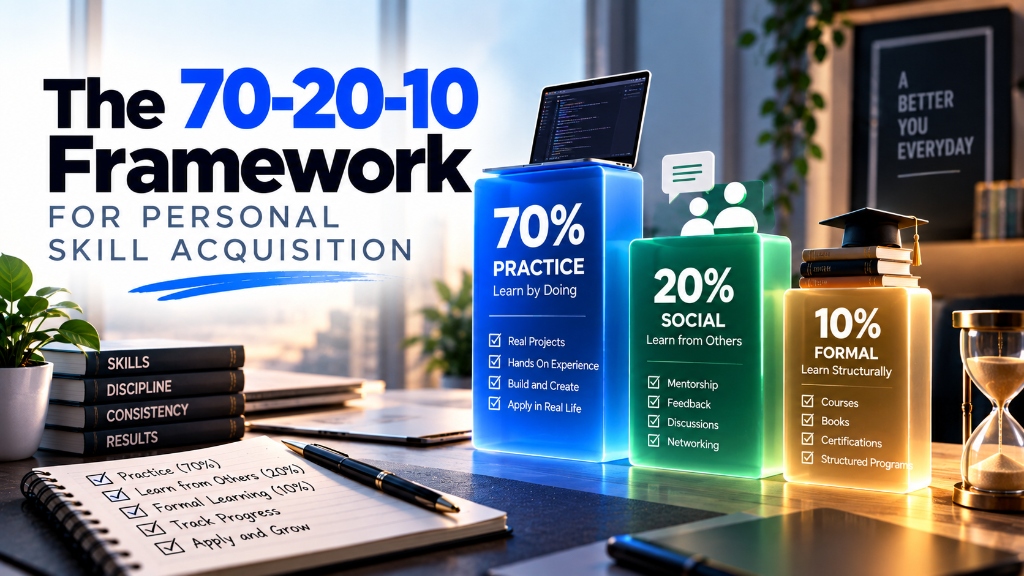
The 70-20-10 framework for skill acquisition dictates that 70% of learning occurs through real-world experiential practice, 20% through developmental feedback and mentorship, and 10% through formal reading and theoretical study. High performers master complex domain skills rapidly by prioritizing immediate hands-on execution over passive media consumption.
The 70-20-10 learning model accelerates skill mastery by grounding knowledge in practical application. Allocate 70% of learning time to real projects with real stakes, 20% to peer feedback and expert coaching, and 10% to books, courses, and documentation.
The illusion of Competence: Consumption vs Execution
The most common mistake learners make is trapped in the 10% theoretical bucket: reading dozens of business books, watching hours of video tutorials, and taking endless online courses without applying the material. Passive consumption creates a psychological illusion of competence because absorbing concepts feels productive, but true skill neural pathways form only during active problem-solving.
                  ┌── 70% Real-World Execution (Hands-on projects with live stakes)
                  │
Skill Building ───┼── 20% Mentorship & Feedback (Code reviews, coaching, peer critique)
                  │
                  └── 10% Theory & Reading (Books, documentation, online courses)
Deconstructing the 3 Learning Buckets
Bucket 1: 70% Experiential Practice (Real Stakes)
Skill mastery requires building real assets under live market conditions. If learning software engineering, build a published web application. If learning copywriting, launch a live email campaign with real spending customers. Real stakes force your brain to engage deep problem-solving routines.
Bucket 2: 20% Developmental Feedback & Mentorship
Working in isolation can reinforce bad habits or inefficient workflows. Seeking weekly code reviews, editorial critiques, or executive coaching provides external course corrections that compress years of trial-and-error into weeks.
Bucket 3: 10% Targeted Theoretical Foundation
Formal reading and documentation study should serve as just-in-time reference material to unblock specific operational hurdles, rather than endless front-loaded reading before taking action.
Strategic comparison: Skill Acquisition Models
| Learning Model | Real-World Application | Retention Rate | Speed to Mastery | Primary Vulnerability |
|---|---|---|---|---|
| Academic / Pure Theory | Very Low (10%) | Poor (15% after 30 days) | Extremely Slow | Infinite delay without execution |
| Unguided Trial & Error | High (90%) | Moderate (Learned hard way) | Slow & Painful | Entrenching bad habits |
| 70-20-10 Accelerated Model | Balanced High (70%) | Maximum (85%+ Retention) | Rapid (3x - 5x Faster) | Requires tolerance for early mistakes |
How to Execute a 30-Day Skill Acceleration Sprint in 4 Steps
Mastering a new high-value skill requires structuring an intense 30-day execution framework.
- Deconstruct the Skill into Core Components: Break a complex skill like “Digital Marketing” into sub-skills: headline copy, landing page design, conversion analytics, and email sequences.
- Commit to a Specific Live Project: Define a concrete tangible deliverable due in 30 days (e.g., “Launch a live landing page selling a $29 ebook”).
- Secure a Review Mentor or Peer Group: Find an expert or accountability group to review your work at Day 15 and Day 30, providing blunt, constructive feedback.
- Cap Passive Reading to 30 Minutes Daily: Limit book or video consumption to a strict 30-minute window before starting 90 minutes of active project building.
Real world case example: Learning Full-Stack Web Development
Consider two aspiring developers attempting to learn full-stack web development:
Student A enrolls in four video courses, watches 120 hours of lectures, and takes exhaustive notes over six months. When asked to build a custom client dashboard from scratch, Student A freezes, unable to configure build pipelines or resolve basic syntax bugs independently.
Student B spends three days reading basic documentation (10%), then immediately starts building a real-time invoice generator app (70%). When stuck on database schema design, Student B pays a senior engineer for a 45-minute code review (20%). Within six weeks, Student B ships a live, functional web application and lands a paid freelance project.
Frequently asked questions
What if I can’t find a mentor for the 20% feedback component?
If direct 1-on-1 mentorship is unavailable, join specialized developer, writing, or masterclass communities where peers conduct public work teardowns. You can also benchmark your work against top industry standards to audit discrepancies.
How do I know when I have spent enough time in the 10% theoretical phase?
You have spent enough time in theory as soon as you understand the basic vocabulary and core workflow steps. Shift to hands-on execution immediately; return to theoretical documentation only when hit with a specific technical blocker.
Can the 70-20-10 framework apply to soft skills like public speaking or leadership?
Yes, the 70-20-10 framework applies directly to soft skills. Master public speaking by delivering 10 live talks (70%), reviewing video recordings with a speech coach (20%), and studying classic rhetoric principles (10%).
Download: The Capital Allocation & Wealth Framework PDF
Get our comprehensive 30-page strategic PDF guide covering asset allocation, business moats, and mental models for long-term compounding.
- High-margin enterprise checklist
- Asset allocation proportion matrix
This article and its associated calculators are for educational and informational purposes only and do not constitute financial, investment, legal, tax, or medical advice. We may earn an affiliate commission on third-party links at zero cost to you. Always consult a licensed professional before making major financial, health, or investment decisions. Read our full Legal & Financial Disclaimer.
Written by Eternity Empire Editorial Team
The Eternity Empire editorial team analyzes personal finance, capital allocation, business strategy, and long-term wealth preservation frameworks.
Was this essay valuable to you?
Help us refine our editorial focus and research priorities.
Reader Discussion (2)
Extremely well-articulated analysis on capital compounding. The breakdown on equity allocation vs active income is spot on.
The distinction between looking rich and building real moats is something more founders need to study deeply.
Explore Eternity Empire
Search insights, browse categories, and discover featured publication guides.
Search Insights
Recent Insights
Further Wisdom & Insights
Explore All Articles →
The Psychology of Long-Term Thinking in a Distracted World
How high performers resist short-term dopamine loops, optimize for second-order consequences, and build compound advantages over 10-year horizons.
The Operating System for Delegating Key Business Tasks
How entrepreneurs delegate operational tasks effectively using outcome-based accountability, SOP documentation, and async workflows.

The Art of Saying No: Protecting Your Highest-Leverage Time
How top executives decline low-value commitments, set strict calendar boundaries, and protect focus time for high-advantage business activities.