

Developing Stoic Calmness Under Extreme Business Pressure
How high-performing leaders apply Stoic philosophy to maintain emotional equilibrium during market downturns and operational crises.
Disclaimer: This article is for educational purposes only and does not constitute financial or legal advice. We may earn an affiliate commission on links at no cost to you.
Read full disclaimer ↓Listen to "Developing Stoic Calmness Under Extreme Business Pressure"
Natural Voice Synthesis • Hands-free listening
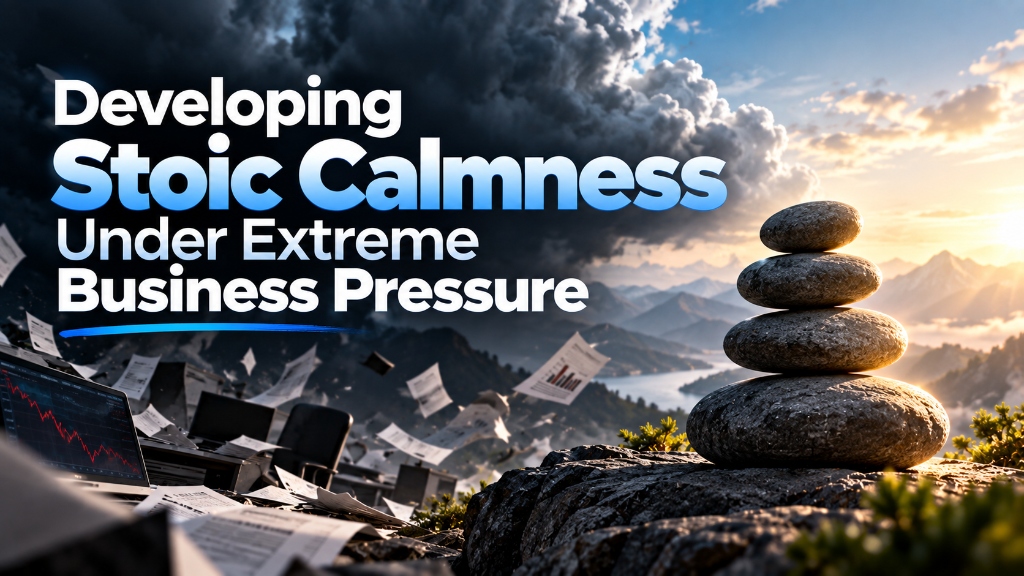
Developing Stoic calmness under business pressure requires separating external events from your internal cognitive reaction. Leaders who master Stoic mental models maintain rational decision making during severe market downturns, client churn, and cash flow crises by focusing exclusively on variables within their direct control.
Stoic calmness is the practice of maintaining composure by dividing all circumstances into things you control and things you don’t control. Cultivate mental resilience during business shocks by enforcing the Dichotomy of Control, practicing negative visualization, and reframing obstacles as raw material for strategic growth.
The core premise: The Dichotomy of Control
At the center of Stoic philosophy lies Epictetus’s Dichotomy of Control: some things are up to us, while others aren’t. In business, market fluctuations, competitor actions, interest rate shifts, and customer sentiment sit entirely outside your direct control. Your effort, strategic choices, emotional reaction, and daily execution sit 100% within your control.
[ External Business Reality (Uncontrollable) ]  ──> Market Crashes, Competitor Moves, Interest Rates
                        │
             [ Cognitive Reframing Filter ]
                        │
[ Internal Executive Response (Controllable) ] ──> Focus, Strategy, Discipline, Action
The three stoic disciplines for Leaders
Stoicism provides three practical mental tools designed to preserve executive decision clarity under stress.
1. The Discipline of Perception (Objective Clarity)
Strip away emotional drama and catastrophic narratives from business problems. A lost client isn’t “a disaster that destroys the company”; it’s simply “a $5,000 monthly account cancellation requiring customer acquisition review”.
2. The Discipline of Action (The Obstacle Is the Way)
View operational friction, product delays, and regulatory challenges as opportunities to strengthen systems. When a major competitor undercuts your pricing, use that constraint to innovate your service delivery or reposition into premium tiers.
3. The Discipline of Will (Amor Fati)
Accept reality as it exists rather than wasting energy wishing circumstances were different. Embracing unchangeable market facts allows you to immediately channel energy into productive solutions.
Strategic comparison: Reactive vs Stoic Leadership
| Dimension | Reactive Leadership Pattern | Stoic Leadership Pattern | Operational Impact |
|---|---|---|---|
| Emotional Baseline | Volatile (Highs on wins, panics on losses) | Steady, Equanimous | Team stability & psychological safety |
| Focus of Attention | External news & competitor actions | Internal execution & system health | Higher output & lower distraction |
| Response to Crisis | Blame, anxiety, paralysis | Immediate objective problem-solving | Rapid recovery from shocks |
| Cognitive Frame | “Why is this happening to me?” | “What does this situation demand of me?” | Decisive leadership action |
How to Cultivate Calmness in 4 Daily Steps
Building mental resilience requires deliberate daily mental practice before major business crises erupt.
- Perform Morning Pre-Meditatio Malorum (Negative Visualization): Spend three minutes every morning contemplating potential challenges (e.g., server downtime, lost sales pitch) to remove shock when setbacks occur.
- Institute a 10-Second Pause Before Responding: When receiving bad news or angry customer emails, count to ten before taking action to allow your prefrontal cortex to override emotional knee-jerk reactions.
- Conduct an Evening Cognitive Audit: Review your daily choices in a private journal: Where did I lose composure? What did I control well? How can I improve my response tomorrow?
- Enforce Physical Regulation: Maintain rigorous sleep hygiene, strength training, and controlled breathing routines. Physical agitation directly amplifies mental anxiety.
Real world case example: Managing a Major Product Outage
Consider an enterprise SaaS founder whose core database crashes on a Monday morning, taking 500 business customers offline.
A reactive founder panics, berates the engineering lead in public Slack channels, sends panicked emails to clients, and burns cognitive energy complaining about server reliability.
A Stoic founder applies the Dichotomy of Control:
- Accepts the outage as an existing fact.
- Directs the team calmly to deploy backup databases.
- Publishes an honest, objective status update to clients stating: “We are currently experiencing a database outage. Our engineering team is executing database restoration. Next update in 30 minutes.”
- After resolution, conducts a blameless post-mortem to build permanent redundancy code.
Frequently asked questions
Does stoic calmness mean suppressing emotions or acting passive?
No, Stoicism isn’t emotional suppression or passive resignation. it’s the active discipline of processing emotions quickly so you can take rational, vigorous action to resolve problems rather than remaining paralyzed by panic.
How do I handle anxiety when cash reserves are dangerously low?
Address cash anxiety by separating real facts from catastrophic projections. List your exact weekly cash burn, audit every expense line item, communicate transparently with creditors, and execute immediate cash-generation activities within your direct control.
Can stoicism improve team performance during company restructuring?
Yes, a leader who maintains Stoic calmness acts as a stabilizing anchor for the entire organization. When executives display rational clarity and emotional poise during uncertainty, team anxiety drops and focus shifts back to execution.
Download: The Capital Allocation & Wealth Framework PDF
Get our comprehensive 30-page strategic PDF guide covering asset allocation, business moats, and mental models for long-term compounding.
- High-margin enterprise checklist
- Asset allocation proportion matrix
This article and its associated calculators are for educational and informational purposes only and do not constitute financial, investment, legal, tax, or medical advice. We may earn an affiliate commission on third-party links at zero cost to you. Always consult a licensed professional before making major financial, health, or investment decisions. Read our full Legal & Financial Disclaimer.
Written by Eternity Empire Editorial Team
The Eternity Empire editorial team analyzes personal finance, capital allocation, business strategy, and long-term wealth preservation frameworks.
Was this essay valuable to you?
Help us refine our editorial focus and research priorities.
Reader Discussion (2)
Extremely well-articulated analysis on capital compounding. The breakdown on equity allocation vs active income is spot on.
The distinction between looking rich and building real moats is something more founders need to study deeply.
Explore Eternity Empire
Search insights, browse categories, and discover featured publication guides.
Search Insights
Recent Insights
Further Wisdom & Insights
Explore All Articles →
The Psychology of Long-Term Thinking in a Distracted World
How high performers resist short-term dopamine loops, optimize for second-order consequences, and build compound advantages over 10-year horizons.
The Operating System for Delegating Key Business Tasks
How entrepreneurs delegate operational tasks effectively using outcome-based accountability, SOP documentation, and async workflows.

The Micro-SaaS Playbook: Building Profitable Niche Software
How solo developers and small teams build, launch, and scale high-margin niche software products to $10k+ recurring monthly revenue.