

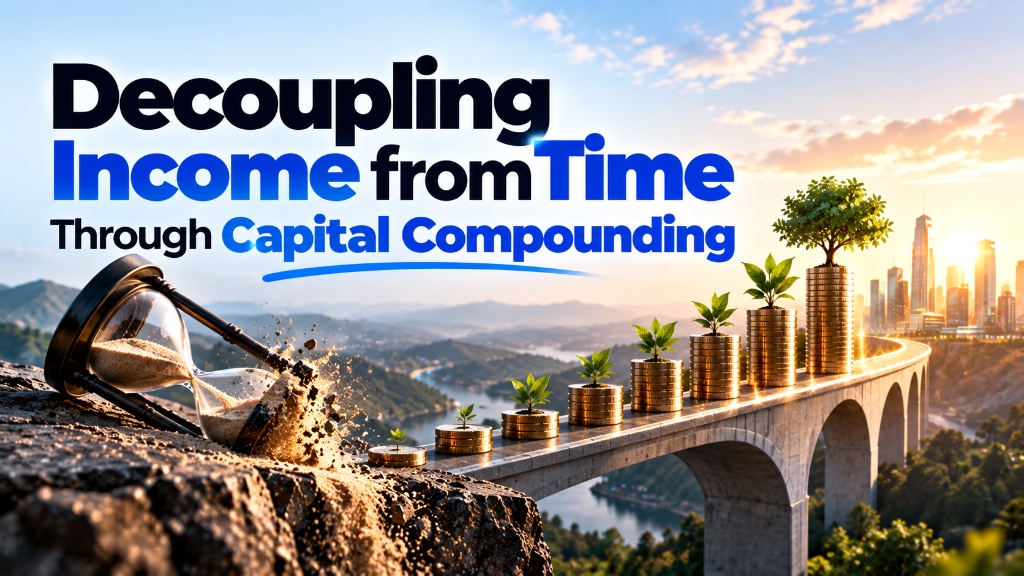
Decoupling Income from Time Through Capital Compounding
How to systematically transition earned active income into self-sustaining capital engines that compound compound returns asynchronously.
Disclaimer: This article is for educational purposes only and does not constitute financial or legal advice. We may earn an affiliate commission on links at no cost to you.
Read full disclaimer ↓Listen to "Decoupling Income from Time Through Capital Compounding"
Natural Voice Synthesis • Hands-free listening
Decoupling income from time requires converting earned active cash flow into self-compounding capital assets. While trading hours for money caps lifetime earning potential, capital assets generate compound returns 24 hours a day regardless of physical presence or active labor output.
Decoupling income from time occurs when your passive asset returns exceed your monthly baseline cost of living. Investors achieve this independence by systematically directing active earnings into cash-flowing assets, reinvesting 100% of dividends during the accumulation phase, and letting exponential compounding work over 10 to 15 year horizons.
The mathematics of Decoupling Income
The transition from active labor to capital independence follows a mathematical curve governed by asset yield, reinvestment velocity, and time horizons. In early accumulation years, capital growth feels imperceptible because earned contributions dwarf investment returns. As portfolio scale crosses critical mass, compound yield eclipses annual earned savings, creating true financial decoupling.
Phase 1: Active Dominance  (Earned Savings > Asset Yield)
Phase 2: The Crossover Point (Earned Savings = Asset Yield)
Phase 3: Capital Autonomy   (Asset Yield > Total Living Outflows)
The three stages of Wealth Acceleration
Building a self-compounding capital engine requires advancing through three distinct operational phases.
Stage 1: Active Surplus Generation
You maximize high-income skills or business cash flows to generate a 40%+ savings rate. Without a substantial active cash surplus, compounding lacks the initial fuel required to build momentum.
Stage 2: Automated Asset Conversion
You automatically sweep surplus cash into productive assets like index funds, cash-flowing real estate, or cash-yield businesses. Reinvestment occurs instantly to prevent cash drag and emotional market timing.
Stage 3: Exponential Reinvestment Loops
All dividends, rental distributions, and interest payouts are automatically plowed back into purchasing additional asset units. Reinvestment speeds up the crossover point where passive capital returns outpace personal living costs.
Strategic comparison: Income Models
| Income Model | Time Scalability | Growth Trajectory | Tax Efficiency | Autonomy Score |
|---|---|---|---|---|
| Hourly W-2 Employment | Zero (Capped by Hours) | Linear (+2% - 5% Raise) | Low (Highest Tax Brackets) | 1 / 10 |
| High-Ticket Solo Service | Low (Capped by Rate) | Capped Sub-Linear | Moderate | 4 / 10 |
| Equity Business Ownership | High (Scaled by Team/Code) | Exponential Potential | High (Capital Gains) | 7 / 10 |
| Automated Capital Portfolio | Infinite (Zero Labor Time) | Exponential Compounding | Maximum (Step-up Basis / Qualified Yield) | 10 / 10 |
How to Build a Self-Compounding Capital Engine in 4 Steps
Escaping the time-for-money trap requires establishing strict financial rules that protect investment capital from lifestyle inflation.
- Fix Your Lifestyle Baseline: Cap personal annual living expenses for 36 months so every salary increase or bonus flows directly into investment capital.
- Automate Weekly Capital Deployments: Set up automatic weekly transfers from checking accounts into low-cost index funds or automated brokerage portfolios.
- Turn On Dividend Reinvestment (DRIP): Program your brokerage accounts to automatically reinvest every dividend check back into buying fractional shares.
- Track Your Freedom Ratio: Calculate monthly asset returns divided by monthly living expenses. Celebrate reaching 25%, 50%, 75%, and 100% autonomy milestones.
Real world case example: The Power of 15-Year Reinvestment
Consider two professionals earning $150,000 annually over 15 years:
Professional A upgrades their home, leases luxury vehicles, and saves 5% ($7,500/year). After 15 years at an 8% market return, their net investment portfolio totals $203,000, generating $16,200 annually. They remain 100% dependent on daily active labor.
Professional B caps living expenses, saves 35% ($52,500/year), and automatically reinvests all dividends. After 15 years at an 8% market return, their portfolio exceeds $1,425,000, generating $114,000 in passive annual returns. Professional B achieves complete financial autonomy, as passive capital payouts cover 100% of baseline living costs.
Frequently asked questions
What portfolio size is required to achieve complete time decoupling?
Complete time decoupling typically requires a portfolio equal to 25 times your annual baseline living expenses. Based on the widely tested 4% safe withdrawal rule, a $1,000,000 portfolio safely provides $40,000 in annual inflation-adjusted income indefinitely.
Is capital compounding safe during severe economic recessions?
Capital compounding remains safe over long horizons if your asset allocation avoids excessive advantage and concentrated single-company risk. Diversified low-cost global index funds and quality real estate have historically recovered from every major economic recession in modern history.
Should I pay off a 3% mortgage or invest in compounding assets?
Financially, investing surplus capital into assets yielding 7% to 10% generates far greater long-term wealth than paying off low-interest debt under 4%. However, paying off a mortgage provides psychological peace of mind, so some investors split surplus capital 80/20 between investing and debt reduction.
Download: The Capital Allocation & Wealth Framework PDF
Get our comprehensive 30-page strategic PDF guide covering asset allocation, business moats, and mental models for long-term compounding.
- High-margin enterprise checklist
- Asset allocation proportion matrix
This article and its associated calculators are for educational and informational purposes only and do not constitute financial, investment, legal, tax, or medical advice. We may earn an affiliate commission on third-party links at zero cost to you. Always consult a licensed professional before making major financial, health, or investment decisions. Read our full Legal & Financial Disclaimer.
Written by Eternity Empire Editorial Team
The Eternity Empire editorial team analyzes personal finance, capital allocation, business strategy, and long-term wealth preservation frameworks.
Was this essay valuable to you?
Help us refine our editorial focus and research priorities.
Reader Discussion (2)
Extremely well-articulated analysis on capital compounding. The breakdown on equity allocation vs active income is spot on.
The distinction between looking rich and building real moats is something more founders need to study deeply.
Explore Eternity Empire
Search insights, browse categories, and discover featured publication guides.
Search Insights
Recent Insights
Further Wisdom & Insights
Explore All Articles →
Bitcoin in 2026: Price, Why It's Dropping, and What Comes Next
Bitcoin is near $83,000 after a big drop from its high. Here is why it is falling, what $1,000 would be worth, and if it is too late to buy.

Apple Pay India Launch: How to Set It Up, Where It Works, and What's Missing (2026)
Apple Pay is now live in India with Axis Bank. See how to set it up, which cards work, where to use it, and why UPI is not included yet.
How to Save Money: 12 Simple Ways to Start Saving Today
Learn how to start saving money with easy tips, a fun savings challenge, and the best apps. Find out how much to save each month and what to keep in a savings account.