

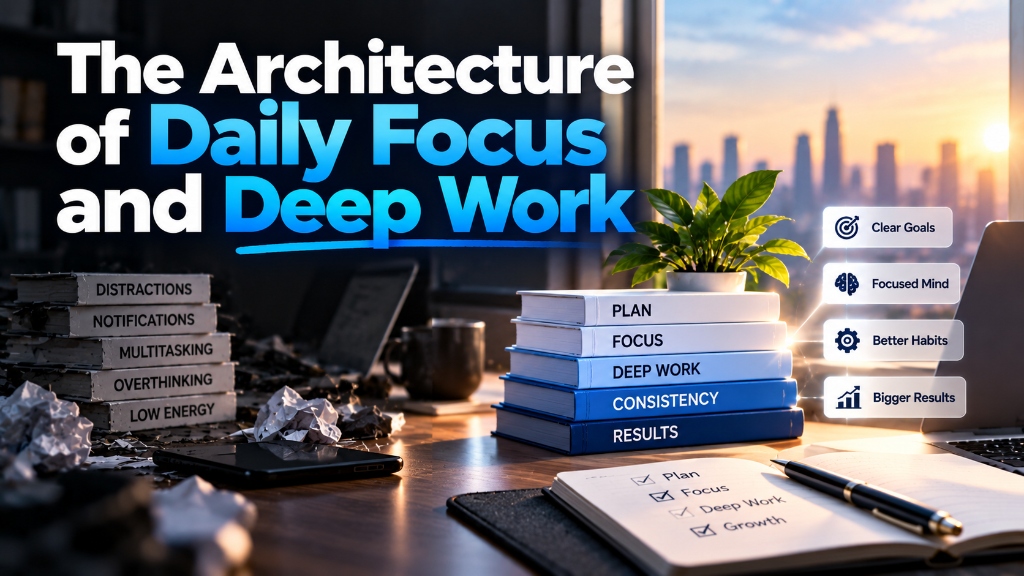
The Architecture of Daily Focus and Deep Work
How high performers eliminate cognitive distraction to achieve sustained daily flow state and compounding creative output.
Disclaimer: This article is for educational purposes only and does not constitute financial or legal advice. We may earn an affiliate commission on links at no cost to you.
Read full disclaimer ↓Listen to "The Architecture of Daily Focus and Deep Work"
Natural Voice Synthesis • Hands-free listening
The architecture of daily focus and deep work relies on structuring distraction-free time blocks to build uninterrupted cognitive immersion. By eliminating notification friction and managing mental energy cycles, professionals produce high-value creative and analytical output that can’t be replicated by reactive multi-tasking.
Deep work is the ability to focus without distraction on a cognitively demanding task. In a digital economy dominated by reactive communications, protecting daily 90-minute focus blocks is a major competitive advantage. Eliminate attention residue, schedule work according to biological energy peaks, and treat focus calendar blocks as non-negotiable appointments.
what’s deep work and Why Is It Rare?
Deep work, a term popularized by computer science professor Cal Newport, refers to professional activities performed in a state of distraction-free concentration that push cognitive capabilities to their limit.
Modern workplace communication channels (messaging apps, instant notifications, email threads) create a state of constant shallow work. Shallow work consists of non-cognitively demanding, logistical tasks performed while distracted. While shallow work keeps you busy, only deep work creates new economic value and skill mastery.
The cognitive science of Attention Residue
When you switch from a primary strategic task to quickly check an email or notification, your brain doesn’t instantly shift attention. A portion of your cognitive processing remains stuck evaluating the previous message: a phenomenon known as attention residue.
Research indicates that frequent context switching reduces functional cognitive performance by up to 40%, leaving professionals mentally exhausted while producing minimal tangible progress.
Focus isn’t about saying yes to key priorities; it’s about protecting your calendar against low-value noise.
The 4-Step Deep Work Scheduling Protocol
Implement these protocols to structure your daily focus architecture:
- Schedule 90-Minute Focus Blocks: Reserve two 90-minute distraction-free blocks during your biological peak energy windows (typically early morning).
- Implement Communication Blackouts: Close all email clients, team chat apps, and mobile notifications during focus blocks.
- Batch Administrative Shallow Work: Group messaging responses, email management, and quick administrative tasks into dedicated low-energy afternoon windows.
- Create a Shut-Down Ritual: End your workday with an explicit task review to clear mental open loops before transitioning to evening recovery.
Practical example: Deep Work vs. Shallow Work Schedule
Compare two software engineer daily schedules:
- Engineer A (Reactive): Keeps email and team chat open continuously. Responds to messages within 3 minutes while trying to write code. Experiences constant context switching and spends 10 hours working, completing 1 complex feature per week.
- Engineer B (Deep Work System): Blocks 8:30 AM to 11:30 AM for uninterrupted coding with all notifications muted. Checks communications twice daily at 1:00 PM and 4:30 PM. Completes 3 complex features per week in 8 hours daily.
Comparison: Focus Management Techniques
| Focus Strategy | Primary Mechanism | Cognitive Impact | Best Use Case | Implementation Difficulty |
|---|---|---|---|---|
| 90-Minute Time Blocking | Fixed distraction-free blocks | Maximum flow state | Complex problem solving | Moderate |
| Pomodoro Technique | 25-min focus / 5-min rest | High focus sustain | Medium-complexity tasks | Easy |
| Batch Processing | Grouping administrative tasks | Reduces attention residue | Email & communications | Easy |
| Open Door Availability | Constant real-time response | Severe context switching | Crisis management only | Disastrous long-term |
Common failure modes in Focus Design
Watch out for these common obstacles to sustained daily concentration:
- Confusing Busyness With Productivity: Answering 100 emails gives a false sense of accomplishment while producing zero compound equity.
- Underestimating Environmental Cues: Leaving digital tabs or phone screens visible creates subconscious attention draw. Place devices in another room.
- Neglecting Rest and Recovery: High-cognition focus consumes intense glucose reserves. Without quality sleep and physical exercise, deep work capacity degrades rapidly.
Frequently asked questions
How many hours of deep work can a person sustain per day?
Research shows that most elite performers can sustain a maximum of 3 to 4 hours of intense deep work per day split into two blocks. Quality of focus matters more than total hours spent.
What should I do if my job requires constant communication responsiveness?
Establish clear expectations with your team regarding response times. Propose fixed 2-hour quiet focus blocks where response times are paused to deliver core project assets.
How does caffeine impact deep work focus?
Caffeine boosts alertness by blocking adenosine receptors, but taking it immediately upon waking disrupts natural cortisol rhythms. Delay caffeine intake 90 minutes after waking for optimal focus.
Strategic recommendation
block out 90 minutes on your calendar for tomorrow morning dedicated exclusively to your highest-value strategic asset, and close all communication applications during that window.
Download: The Capital Allocation & Wealth Framework PDF
Get our comprehensive 30-page strategic PDF guide covering asset allocation, business moats, and mental models for long-term compounding.
- High-margin enterprise checklist
- Asset allocation proportion matrix
This article and its associated calculators are for educational and informational purposes only and do not constitute financial, investment, legal, tax, or medical advice. We may earn an affiliate commission on third-party links at zero cost to you. Always consult a licensed professional before making major financial, health, or investment decisions. Read our full Legal & Financial Disclaimer.
Written by Eternity Empire Editorial Team
The Eternity Empire editorial team analyzes personal finance, capital allocation, business strategy, and long-term wealth preservation frameworks.
Was this essay valuable to you?
Help us refine our editorial focus and research priorities.
Reader Discussion (2)
Extremely well-articulated analysis on capital compounding. The breakdown on equity allocation vs active income is spot on.
The distinction between looking rich and building real moats is something more founders need to study deeply.
Explore Eternity Empire
Search insights, browse categories, and discover featured publication guides.
Search Insights
Recent Insights
Further Wisdom & Insights
Explore All Articles →
The Psychology of Long-Term Thinking in a Distracted World
How high performers resist short-term dopamine loops, optimize for second-order consequences, and build compound advantages over 10-year horizons.
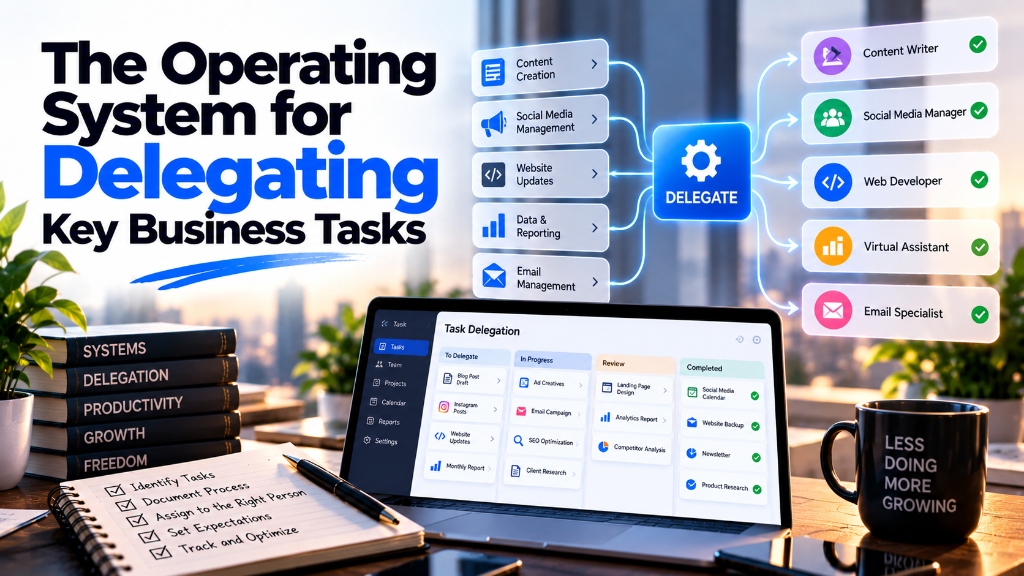
The Operating System for Delegating Key Business Tasks
How entrepreneurs delegate operational tasks effectively using outcome-based accountability, SOP documentation, and async workflows.

The Art of Saying No: Protecting Your Highest-Leverage Time
How top executives decline low-value commitments, set strict calendar boundaries, and protect focus time for high-advantage business activities.