

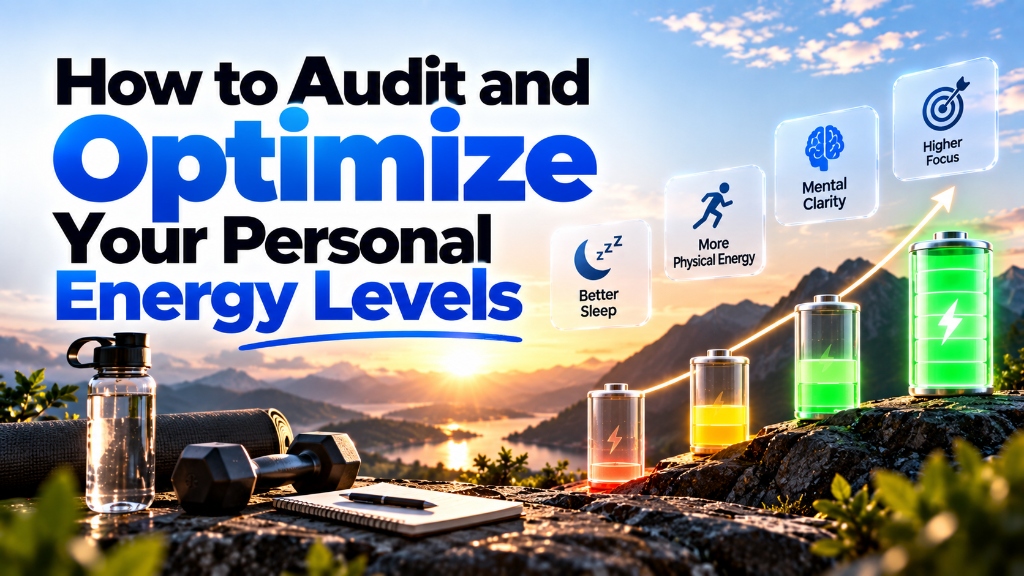
How to Audit and Optimize Your Personal Energy Levels
How high performers manage circadian rhythms, track cognitive energy peaks, and build active recovery protocols for sustained output.
Disclaimer: This article is for educational purposes only and does not constitute financial or legal advice. We may earn an affiliate commission on links at no cost to you.
Read full disclaimer ↓Listen to "How to Audit and Optimize Your Personal Energy Levels"
Natural Voice Synthesis • Hands-free listening
Auditing and optimizing your personal energy levels requires treating physical and cognitive energy as a finite resource managed through circadian alignment, nutrition, and structured recovery protocols. High performers optimize energy management rather than just time management, ensuring that high-stakes work coincides with peak cognitive focus.
Personal energy optimization is the practice of tracking daily energy fluctuations and matching complex cognitive tasks to peak alertness windows. Optimize personal energy by auditing daily energy cycles for 7 days, protecting morning circadian focus peaks for deep work, and establishing non-negotiable sleep hygiene routines.
Time management vs Energy Management
Managing time without managing energy leads to burn-out and poor output quality. Having four open hours on your calendar at 3:00 PM is useless if you are suffering from severe brain fog, decision fatigue, or caffeine crashes. High output requires matching high-friction tasks (strategy, writing, coding) to high-energy windows, while relegating low-friction tasks (email, admin) to low-energy windows.
[ Peak Cognitive Energy Window (9 AM - 12 PM) ] ──> Deep Work (Strategy, Writing, Code)
[ Low Cognitive Energy Window  (2 PM - 4 PM)  ] ──> Shallow Work (Email, Admin, Meetings)
The four energy dimensions
sustained elite output requires optimizing four interconnected physical and psychological energy reservoirs.
1. Physical Energy (Sleep, Nutrition, Movement)
Physical energy forms the foundation. high quality sleep (7-8 hours), hydration, whole-food nutrition, and daily movement dictate base cellular energy production.
2. Emotional Energy (Quality of Feelings)
Negative emotions like anxiety, frustration, and resentment drain cognitive reserves. Cultivating psychological safety, Stoic calmness, and clear boundaries preserves emotional capacity.
3. Mental Energy (Focus and Attention Control)
Mental energy is depleted by constant task-switching and notifications. Protecting single-task focus blocks preserves executive prefrontal cortex capacity.
4. Spiritual Energy (Alignment with Purpose)
Spiritual energy comes from doing work aligned with your core values and long-term vision. Work that feels meaningful generates intrinsic motivation and resilience.
Strategic comparison: Energy Optimization Models
| Dimension | Reactive Energy Pattern | Optimized Energy Pattern | Impact on Output |
|---|---|---|---|
| Circadian Alignment | Schedules deep work randomly | Matches complex tasks to morning peak | 2x - 3x faster task completion |
| Caffeine Protocol | Drinks coffee immediately upon waking | Delays caffeine 90 minutes post-waking | Eliminates 2 PM afternoon crash |
| Recovery Management | Works continuously until burnout | Schedules 90-minute work/break sprints | Sustained long-term productivity |
| Environment | Constant notifications & noise | Silent workspace & batch processing | High-depth cognitive concentration |
How to Conduct a 7-Day Energy Audit in 4 Steps
Optimizing your energy requires gathering real-world personal data across your daily routine.
- Track Hourly Energy Levels for 7 Days: Set an hourly alarm and rate your physical alertness and mental focus on a scale from 1 to 10 in a quick log sheet.
- Identify Your Peak Alertness Chronotype: Plot your scores to discover your 3-hour peak cognitive window (typically 2 to 4 hours after waking).
- Lock In Your Deep Work Peak: Block your 3-hour peak window in your calendar strictly for high-advantage priorities, prohibiting meetings or email checks during this block.
- Implement the 90-Minute Caffeine Delay Protocol: Wait 90 to 120 minutes after waking before consuming your first cup of coffee to allow adenosine to clear naturally and prevent afternoon crashes.
Real world case example: Eliminating the 2 PM Crash
Consider a software founder who experiences severe brain fog, fatigue, and irritability every day between 2:00 PM and 4:30 PM:
The founder conducts a 7-day audit and discovers three root causes:
- Drinks two large cups of coffee immediately upon waking at 6:30 AM.
- Eats a high-carbohydrate lunch (pasta/sandwiches) at 12:30 PM.
- Schedules complex product architecture meetings at 2:30 PM.
The founder implements an energy overhaul:
- Delays first coffee until 8:30 AM (90 minutes post-waking).
- Shifts lunch to a high-protein, low-glycemic meal (salmon and green vegetables).
- Moves product architecture meetings to 10:00 AM (peak window) and schedules administrative email processing for 2:30 PM.
Afternoon brain fog disappears completely, daily cognitive output increases by 40%, and sleep quality improves.
Frequently asked questions
Why does drinking coffee immediately upon waking cause an afternoon crash?
Upon waking, your body naturally clears adenosine (the chemical that causes sleepiness). Consuming caffeine immediately blocks adenosine receptors without clearing the chemical. When caffeine wears off 6 hours later, accumulated adenosine binds to receptors simultaneously, causing a severe 2 PM crash.
How much sleep do high-performing adults really need?
Peer-reviewed sleep research demonstrates that over 99% of adults require 7 to 9 hours of sleep per night for optimal cognitive function, immune health, and memory consolidation. Chronic sleep deprivation under 6 hours degrades executive function equivalent to legal alcohol intoxication.
what’s non-sleep deep rest (NSDR) and does it work?
Non-sleep deep rest (NSDR) or Yoga Nidra is a 10 to 20-minute guided relaxation protocol that slows brainwave activity. Research shows a 20-minute NSDR session can restore dopamine levels, lower mental fatigue, and replenish energy for afternoon work sessions.
Download: The Capital Allocation & Wealth Framework PDF
Get our comprehensive 30-page strategic PDF guide covering asset allocation, business moats, and mental models for long-term compounding.
- High-margin enterprise checklist
- Asset allocation proportion matrix
This article and its associated calculators are for educational and informational purposes only and do not constitute financial, investment, legal, tax, or medical advice. We may earn an affiliate commission on third-party links at zero cost to you. Always consult a licensed professional before making major financial, health, or investment decisions. Read our full Legal & Financial Disclaimer.
Written by Eternity Empire Editorial Team
The Eternity Empire editorial team analyzes personal finance, capital allocation, business strategy, and long-term wealth preservation frameworks.
Was this essay valuable to you?
Help us refine our editorial focus and research priorities.
Reader Discussion (2)
Extremely well-articulated analysis on capital compounding. The breakdown on equity allocation vs active income is spot on.
The distinction between looking rich and building real moats is something more founders need to study deeply.
Explore Eternity Empire
Search insights, browse categories, and discover featured publication guides.
Search Insights
Recent Insights
Further Wisdom & Insights
Explore All Articles →
The Psychology of Long-Term Thinking in a Distracted World
How high performers resist short-term dopamine loops, optimize for second-order consequences, and build compound advantages over 10-year horizons.
The Operating System for Delegating Key Business Tasks
How entrepreneurs delegate operational tasks effectively using outcome-based accountability, SOP documentation, and async workflows.

The Art of Saying No: Protecting Your Highest-Leverage Time
How top executives decline low-value commitments, set strict calendar boundaries, and protect focus time for high-advantage business activities.