

Building a Personal Knowledge Management System
How knowledge workers organize digital information, synthesize research into execution, and build a Second Brain using CODE principles.
Disclaimer: This article is for educational purposes only and does not constitute financial or legal advice. We may earn an affiliate commission on links at no cost to you.
Read full disclaimer ↓Listen to "Building a Personal Knowledge Management System"
Natural Voice Synthesis • Hands-free listening
Building a Personal Knowledge Management (PKM) system requires capturing, organizing, and synthesizing digital information into an external “Second Brain”. Knowledge workers who rely solely on human memory suffer from cognitive overwhelm and lose valuable research, whereas those with a structured PKM transform passive reading into active creative output.
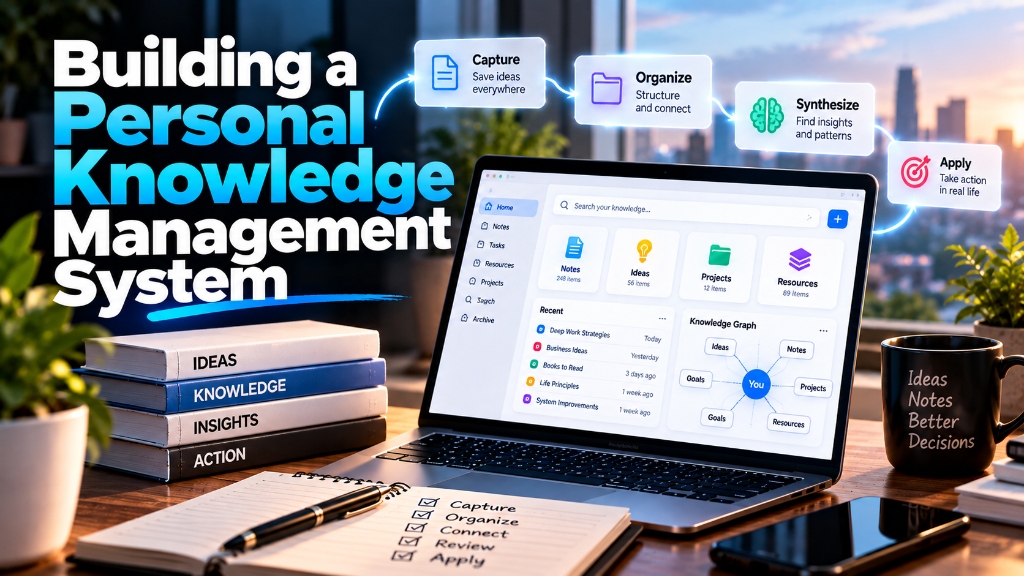
A Personal Knowledge Management (PKM) system is an external digital architecture for storing and retrieving insights. Build an effective Second Brain using the CODE framework: Capture high-value ideas, Organize by active projects (PARA method), Distill core takeaways, and Express insights through published work.
The information overload problem
modern professionals consume megabytes of articles, podcasts, books, and reports daily. Without a PKM system, over 90% of absorbed knowledge is forgotten within 48 hours (Ebbinghaus Forgetting Curve). A Second Brain offloads memory storage to digital software tools, freeing your physical brain for higher-level synthesis, strategy, and creative execution.
The CODE Framework (Tiago Forte Model)
The CODE methodology structures how information moves from initial discovery to finished work.
[ Capture ] ──> Save resonance insights (Readwise, Web Clippers)
     │
[ Organize ] ──> Categorize via PARA (Projects, Areas, Resources, Archives)
     │
[ Distill ] ──> Progressive Summarization (Highlight key takeaways)
     │
[ Express ] ──> Publish finished articles, code, or strategic plans
1. Capture (Keep What Resonates)
Capture only quotes, data points, and concepts that spark immediate interest or relate to active goals. Avoid bookmarking entire articles without extracting specific takeaways.
2. Organize (Organize for Actionability)
Organize information based on where it will be used, rather than where it came from, using the PARA method:
- Projects: Short-term efforts with a specific deadline (e.g., “Launch E-Commerce Site”).
- Areas: Long-term responsibilities to maintain (e.g., “Personal Health”, “Tax Planning”).
- Resources: Topics of ongoing interest (e.g., “AI Prompting”, “Stoic Philosophy”).
- Archives: Inactive items from the other three categories.
3. Distill (Extract the Essence)
Apply Progressive Summarization: bold key sentences on your first review, highlight top phrases on your second pass, and write a 3-bullet executive summary at the top of the note for instant future retrieval.
4. Express (Create Value)
Knowledge is useful only when applied. Convert notes into blog posts, software products, client proposals, or strategic playbooks.
Strategic comparison: PKM Note-Taking Software
| Software Tool | Organization Structure | Search Speed | Best Suited For |
|---|---|---|---|
| Notion | Database Tables & Pages | Fast | Team projects & Structured Workflows |
| Obsidian | Local Markdown & Bi-directional Links | Instant | Deep interconnected research & writing |
| Apple Notes | Simple Folder Trees | Fast | Quick mobile capture & quick memos |
| Roam Research | Networked Graph Database | Fast | Non-linear thinking & academic synthesis |
How to Build Your Second Brain in 4 Steps
Constructing an actionable PKM system takes less than two hours of digital setup.
- Choose a Primary Capture Tool: Install a web clipper extension and sync e-readers to automatically push highlighted text into a central note app.
- Create 4 Top-Level PARA Folders: Set up
1. Projects,2. Areas,3. Resources, and4. Archivesinside your primary note-taking software. - Practice Progressive Summarization: Whenever reviewing captured notes, bold the key insights and write a 2-sentence summary at the top.
- Conduct a Weekly Review: Spend 20 minutes every Sunday clearing your capture inbox, filing notes into PARA folders, and updating active project goals.
Real world case example: Synthesizing Market Research
Consider a strategy consultant tasked with writing a 20-page whitepaper on B2B SaaS retention benchmarks:
Without a PKM system, the consultant spends two weeks searching Google, re-reading book chapters, and hunting through lost browser bookmarks, producing a rushed document under high stress.
With a PKM system, the consultant opens their Resources/SaaS Metrics folder, where 40 tagged research quotes, chart screenshots, and progressive summaries have been automatically collected over six months. The whitepaper is assembled in two days by synthesizing pre-curated notes into a compelling narrative.
Frequently asked questions
what’s the most common mistake people make when starting a Second Brain?
The most common mistake is over-categorizing: spending hours creating hundreds of empty nested folders before capturing real notes. Keep your folder structure flat using PARA and rely on search tags for retrieval.
Should I migrate all my old notes into a new PKM system?
No, don’t waste time organizing legacy notes. Move all existing notes into an Archive/Legacy folder. Only pull old notes into your active PARA structure when you actively need them for a current project.
How much time should I spend maintaining my PKM system?
Maintain your system in under 30 minutes per week. Your PKM system should serve your active work, not become an administrative hobby.
Download: The Capital Allocation & Wealth Framework PDF
Get our comprehensive 30-page strategic PDF guide covering asset allocation, business moats, and mental models for long-term compounding.
- High-margin enterprise checklist
- Asset allocation proportion matrix
This article and its associated calculators are for educational and informational purposes only and do not constitute financial, investment, legal, tax, or medical advice. We may earn an affiliate commission on third-party links at zero cost to you. Always consult a licensed professional before making major financial, health, or investment decisions. Read our full Legal & Financial Disclaimer.
Written by Eternity Empire Editorial Team
The Eternity Empire editorial team analyzes personal finance, capital allocation, business strategy, and long-term wealth preservation frameworks.
Was this essay valuable to you?
Help us refine our editorial focus and research priorities.
Reader Discussion (2)
Extremely well-articulated analysis on capital compounding. The breakdown on equity allocation vs active income is spot on.
The distinction between looking rich and building real moats is something more founders need to study deeply.
Explore Eternity Empire
Search insights, browse categories, and discover featured publication guides.
Search Insights
Recent Insights
Further Wisdom & Insights
Explore All Articles →
The Psychology of Long-Term Thinking in a Distracted World
How high performers resist short-term dopamine loops, optimize for second-order consequences, and build compound advantages over 10-year horizons.
The Operating System for Delegating Key Business Tasks
How entrepreneurs delegate operational tasks effectively using outcome-based accountability, SOP documentation, and async workflows.

The Micro-SaaS Playbook: Building Profitable Niche Software
How solo developers and small teams build, launch, and scale high-margin niche software products to $10k+ recurring monthly revenue.