

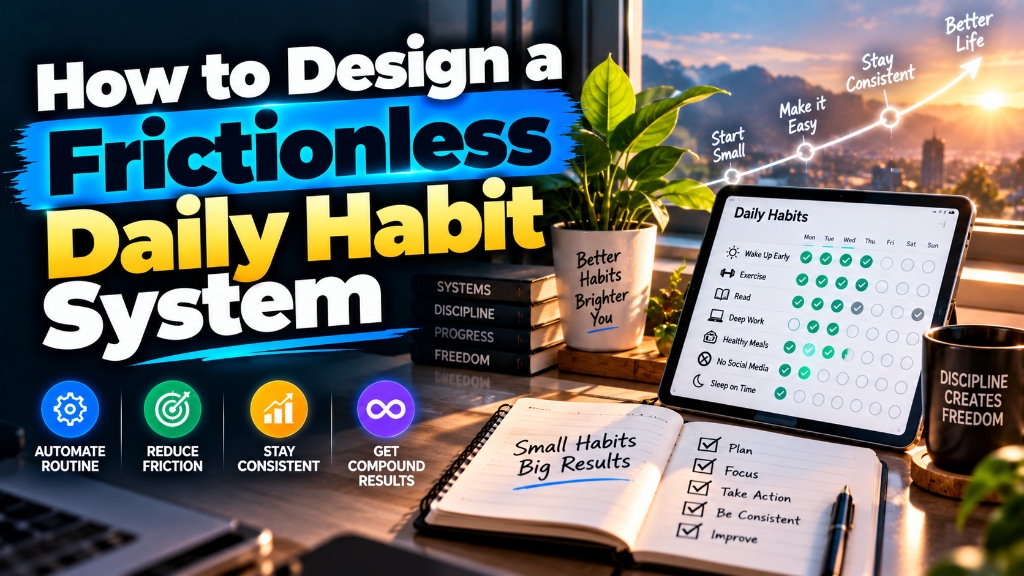
How to Design a Frictionless Daily Habit System
How to build high-performance daily habits by reducing environmental friction, utilizing habit stacking, and tracking streak velocity.
Disclaimer: This article is for educational purposes only and does not constitute financial or legal advice. We may earn an affiliate commission on links at no cost to you.
Read full disclaimer ↓Listen to "How to Design a Frictionless Daily Habit System"
Natural Voice Synthesis • Hands-free listening
Designing a frictionless daily habit system requires structuring your physical and digital environment to make desired behaviors effortless while making destructive habits difficult. Relying on raw willpower is a flawed strategy because mental discipline fluctuates daily based on stress, decision fatigue, and physical energy levels.
A frictionless habit system automates daily execution by optimizing environmental cues and minimizing initial activation energy. Build sustainable habits by reducing starting friction to under two minutes, attaching new behaviors to established daily anchors (habit stacking), and tracking visual consistency using a simple daily habit log.
Why willpower fails: Environment vs Discipline
Willpower is an exhaustible cognitive resource that depletes rapidly throughout the workday. When you rely on willpower to exercise, eat clean, or write code after a long day of decision making, your brain naturally defaults to the path of least resistance. Optimizing your environment eliminates the need for heroic willpower by making execution the default path.
The 4 Laws of Frictionless Habit Design
Based on behavioral psychology, habit formation follows four operational rules:
- Make It Obvious (Cues): Place physical cues for positive habits directly in your daily visual path.
- Make It Attractive (Craving): Pair tasks requiring effort with immediate enjoyable rewards (temptation bundling).
- Make It Easy (Friction Reduction): Lower starting activation energy so beginning takes less than two minutes.
- Make It Satisfying (Reward): Create immediate visual feedback (marking a habit grid) to reinforce neural pathways.
[ Visual Environmental Cue ] ──> [ 2-Minute Easy Starter Action ] ──> [ Immediate Visual Log Reward ]Strategic comparison: Habit Building Approaches
| Approach | Reliance on Willpower | Long-Term Consistency | Failure Rate | Best Applied To |
|---|---|---|---|---|
| Massive Identity Overhaul | Extreme | Very Low (Burns out in 14 days) | 90%+ | Never recommended |
| Goal-Only Focus | High | Low (Stops once goal is hit) | High | One-off target deadlines |
| Environmental Systems Design | Minimal | Maximum (Sustained for years) | Very Low | Core daily identity routines |
How to Build a Frictionless Habit System in 4 Steps
Constructing an automated personal habit operating system takes less than an hour of environmental setup.
- Reduce Activation Energy (The 2-Minute Rule): Scale down new habits so starting takes under two minutes (e.g., replace “Write 1,000 words daily” with “Open document and write 1 sentence”).
- Stack New Habits on Established Anchors: Attach new habits to existing daily routines using the formula: “After I [Established Anchor], I will immediately [New Micro-Habit].”
- Redesign Physical and Digital Spaces: Put your gym clothes next to your bed, remove snacks from kitchen counters, and move distracting phone apps into hidden folders.
- Enforce the “Never Miss Twice” Rule: If travel or sickness interrupts your habit streak for one day, prioritize executing a micro-version the very next day to preserve identity momentum.
Real world case example: Establishing a Morning Writing Habit
Consider an entrepreneur struggling for two years to write daily business articles:
Under the old willpower approach, the entrepreneur wakes up, checks email, drinks coffee, and tries to “find time to write” at 4:00 PM. By late afternoon, decision fatigue sets in, meetings run long, and zero words get written.
Under the frictionless system approach:
- Environment: The laptop is left on the desk overnight with a blank document open and phone left in the kitchen.
- Habit Stack: “After I pour my morning coffee (Anchor), I will sit at the desk and write 100 words (New Habit).”
- Outcome: Starting is effortless. The 100-word micro-habit consistently builds momentum, resulting in 500+ finished words daily before 9:00 AM.
Frequently asked questions
How long does it actually take to form a new daily habit?
While popular myth claims habits form in 21 days, peer-reviewed behavioral research shows forming a automatic habit takes between 18 and 66 days, depending on task complexity and environmental consistency.
What should I do when I lose motivation for my habit system?
Focus on identity consistency rather than performance output. On low-motivation days, execute a 60-second micro-version of the habit (e.g., doing 5 pushups instead of a 45-minute workout) to preserve your identity as someone who shows up daily.
How many new habits should I attempt to build simultaneously?
Focus on establishing a single new core habit at a time. Trying to overhaul sleep, diet, exercise, and deep work routines all in one week overwhelms cognitive capacity and leads to system collapse.
Download: The Capital Allocation & Wealth Framework PDF
Get our comprehensive 30-page strategic PDF guide covering asset allocation, business moats, and mental models for long-term compounding.
- High-margin enterprise checklist
- Asset allocation proportion matrix
This article and its associated calculators are for educational and informational purposes only and do not constitute financial, investment, legal, tax, or medical advice. We may earn an affiliate commission on third-party links at zero cost to you. Always consult a licensed professional before making major financial, health, or investment decisions. Read our full Legal & Financial Disclaimer.
Written by Eternity Empire Editorial Team
The Eternity Empire editorial team analyzes personal finance, capital allocation, business strategy, and long-term wealth preservation frameworks.
Was this essay valuable to you?
Help us refine our editorial focus and research priorities.
Reader Discussion (2)
Extremely well-articulated analysis on capital compounding. The breakdown on equity allocation vs active income is spot on.
The distinction between looking rich and building real moats is something more founders need to study deeply.
Explore Eternity Empire
Search insights, browse categories, and discover featured publication guides.
Search Insights
Recent Insights
Further Wisdom & Insights
Explore All Articles →
The Psychology of Long-Term Thinking in a Distracted World
How high performers resist short-term dopamine loops, optimize for second-order consequences, and build compound advantages over 10-year horizons.

The Operating System for Delegating Key Business Tasks
How entrepreneurs delegate operational tasks effectively using outcome-based accountability, SOP documentation, and async workflows.

The Art of Saying No: Protecting Your Highest-Leverage Time
How top executives decline low-value commitments, set strict calendar boundaries, and protect focus time for high-advantage business activities.