

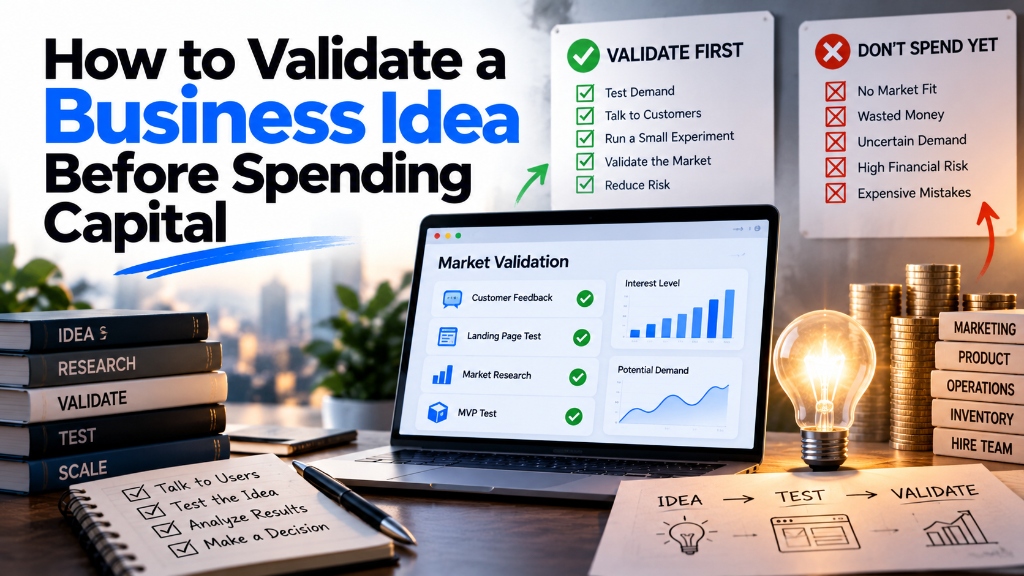
How to Validate a Business Idea Before Spending Capital
A step-by-step validation framework for testing market demand, collecting presales, and confirming buyer willingness to pay.
Disclaimer: This article is for educational purposes only and does not constitute financial or legal advice. We may earn an affiliate commission on links at no cost to you.
Read full disclaimer ↓Listen to "How to Validate a Business Idea Before Spending Capital"
Natural Voice Synthesis • Hands-free listening
Validating a business idea requires securing financial or behavioral commitments from target customers before spending engineering or manufacturing capital. Building a product in isolation based on unverified assumptions is the primary cause of early-stage enterprise failure.
Business validation is the process of testing market demand using real customer commitments before building a complete solution. Validate ideas by conducting 15 problem discovery interviews, building a high-converting landing page with a clear value proposition, and requiring deposit prepayments or LOIs to prove genuine willingness to pay.
Why verbal interest isn’t validation
polite praise from friends, family, or survey respondents doesn’t equal market validation. When asked hypothetically if they would buy a proposed product, people consistently answer yes to avoid conflict. True market validation only occurs when a potential buyer transfers money, provides credit card authorization, or signs a binding Letter of Intent (LOI).
The 3-Phase Validation Funnel
To validate a business idea efficiently, guide prospective buyers through three progressive testing gates.
Phase 1: Problem Discovery (15 In-Depth Customer Interviews)
           │
Phase 2: Offer Signal Test (Landing Page + Waiting List Deposit)
           │
Phase 3: Financial Pre-Sales (Pre-orders / Binding LOI Contracts)
Phase 1: Problem Discovery Interviews
Conduct structured interviews with target buyers without mentioning your product idea. Focus exclusively on understanding their current operational pain points, how much money the problem costs them, and what workaround tools they currently pay for.
Phase 2: Landing Page Signal Testing
Publish a high-converting single-page website detailing your proposed solution’s exact value proposition, pricing structure, and call-to-action. Run target traffic via search ads or organic outreach to measure click-through and signup conversion rates.
Phase 3: Financial Pre-Sale Verification
Offer early-access founding discounts to prospects who pay a deposit or pre-order before product launch. If buyers hesitate to input payment details, your positioning or offer lacks sufficient value.
Strategic comparison: Validation Methodologies
| Validation Method | Financial Cost | Speed to Signal | Accuracy of Market Signal | Primary Danger |
|---|---|---|---|---|
| Hypothetical Survey | Free | Fast (1 - 2 Days) | Very Low (False Positives) | Building useless products |
| Problem Discovery Calls | Free | Moderate (1 Week) | High (Pain Understanding) | Over-indexing on one user |
| Smoke Test Landing Page | Low ($50 - $200) | Fast (3 - 5 Days) | Moderate (Intent Signal) | High bounce without ads |
| Presales / Paid Deposit | Free / Negative | Moderate (2 Weeks) | 100% Absolute Signal | Delivery pressure |
How to Execute a 14-Day Validation Sprint in 4 Steps
A structured 14-day validation sprint provides definitive market clarity without wasting engineering resources.
- Write a Specific Problem Hypothesis: Define who your buyer is, their exact operational bottleneck, and the measurable financial impact of solving that bottleneck.
- Conduct 15 Problem Discovery Calls: Interview target buyers using open-ended questions like “How do you currently handle X?” and “what’s the most frustrating part of that process?”
- Build a Smoke Test Landing Page: Create a simple page using web design best practices outlining the transformation, pricing tier, and an “Apply for Early Access” payment button.
- Drive 500 Targeted Visitors: Direct intent-driven traffic through niche communities, LinkedIn messaging, or Google Search ads, targeting a minimum 5% email conversion or 1% presale conversion rate.
Real world case example: Software Agency vs Pre-Seller
Consider two founders attempting to launch a specialized B2B compliance software tool:
Founder A spends six months and $40,000 hiring contractors to build a fully featured web application. Upon launch, Founder A discovers that target corporate compliance officers require single-sign-on (SSO) integrations that the software lacks. The product gets zero sales, and $40,000 is burned.
Founder B creates a simple landing page outlining the software concept with interactive wireframes and offers a 50% lifetime discount for founding members who pre-order for $500. Founder B pitches 20 compliance officers directly, securing 8 paid pre-orders ($4,000 capital raised) while learning exact feature requirements before writing a single line of code.
Frequently asked questions
What conversion rate indicates a validated landing page?
A validated landing page typically achieves a 5% to 10% conversion rate for free waiting list signups, or a 1% to 3% conversion rate for direct paid pre-orders from cold targeted traffic.
What should I do if my presale test receives zero orders?
If your presale test receives zero orders, interview the prospects who clicked your page but did not buy. Ask what prevented them from purchasing. Use their feedback to pivot your pricing, positioning, or core value proposition before re-testing.
Is pre-selling legal if the product isn’t built yet?
Pre-selling is completely legal provided you clearly disclose that the product is currently in active development, state a realistic delivery timeline, and guarantee full refunds if delivery milestones aren’t met.
Download: The Capital Allocation & Wealth Framework PDF
Get our comprehensive 30-page strategic PDF guide covering asset allocation, business moats, and mental models for long-term compounding.
- High-margin enterprise checklist
- Asset allocation proportion matrix
This article and its associated calculators are for educational and informational purposes only and do not constitute financial, investment, legal, tax, or medical advice. We may earn an affiliate commission on third-party links at zero cost to you. Always consult a licensed professional before making major financial, health, or investment decisions. Read our full Legal & Financial Disclaimer.
Written by Eternity Empire Editorial Team
The Eternity Empire editorial team analyzes personal finance, capital allocation, business strategy, and long-term wealth preservation frameworks.
Was this essay valuable to you?
Help us refine our editorial focus and research priorities.
Reader Discussion (2)
Extremely well-articulated analysis on capital compounding. The breakdown on equity allocation vs active income is spot on.
The distinction between looking rich and building real moats is something more founders need to study deeply.
Explore Eternity Empire
Search insights, browse categories, and discover featured publication guides.
Search Insights
Recent Insights
Further Wisdom & Insights
Explore All Articles →
The Psychology of Long-Term Thinking in a Distracted World
How high performers resist short-term dopamine loops, optimize for second-order consequences, and build compound advantages over 10-year horizons.
The Operating System for Delegating Key Business Tasks
How entrepreneurs delegate operational tasks effectively using outcome-based accountability, SOP documentation, and async workflows.
The Micro-SaaS Playbook: Building Profitable Niche Software
How solo developers and small teams build, launch, and scale high-margin niche software products to $10k+ recurring monthly revenue.