

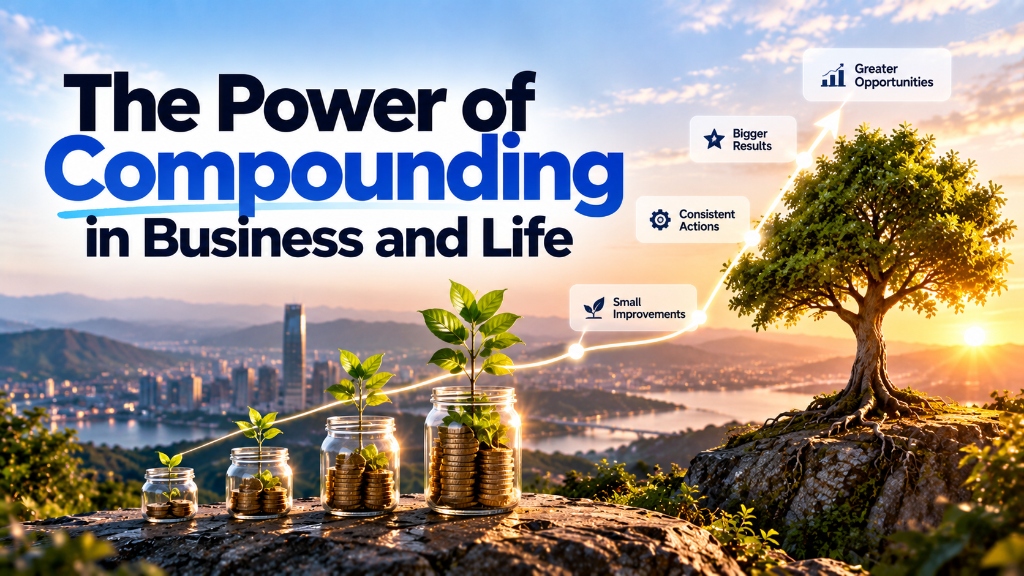
The Power of Compounding in Business and Life
Albert Einstein called compound interest the eighth wonder of the world. Here is how compounding applies to knowledge, relationships, and career authority.
Disclaimer: This article is for educational purposes only and does not constitute financial or legal advice. We may earn an affiliate commission on links at no cost to you.
Read full disclaimer ↓Listen to "The Power of Compounding in Business and Life"
Natural Voice Synthesis • Hands-free listening
The power of compounding in business and life describes how small, consistent inputs accumulate exponentially over time to yield massive non-linear results. While compounding is famous in financial interest calculations, its most profound application occurs across human knowledge, professional relationships, reputation, and brand authority.
Compounding is the exponential growth generated when returns from past efforts generate their own returns. Small daily improvements (1% daily) aggregate to 37x performance growth over a year. Apply long-term compounding principles across financial portfolios, mental models, trust-based networks, and digital brand equity.
Understanding the Mathematics of Compounding
Compounding occurs when growth yields accumulate on top of previously earned growth. Most people intuitively think in linear terms: assuming that equal inputs yield equal outputs over time. Compounding functions on an exponential curve where progress seems imperceptible initially, but accelerates dramatically past a critical tipping point.
Linear Growth:   1 + 1 + 1 + 1 = 4
Exponential:     (1.01)^365 = 37.78  (1% Daily Improvement)
Exponential Decay: (0.99)^365 = 0.03  (1% Daily Regression)
Small daily disciplines compound into life-changing mastery, while minor daily oversights compound into systemic failure.
4 arenas Where Compounding Creates Exponential Advantages
Compounding operates far beyond money. Apply its mechanics across these four domain areas:
1. Compounding Knowledge and Mental Models
Reading 20 pages of authoritative non-fiction daily equals 30 books per year. Over a decade, accumulating 300 books of mental models enables cross-domain pattern recognition that makes strategic decision making effortless.
2. Compounding Professional Reputation and Trust
High integrity displayed across decades creates an unshakeable personal brand. In high-stakes business deals, a trusted reputation eliminates legal friction and attracts premier partners automatically.
3. Compounding Digital Brand Equity
Publishing high quality technical content consistently builds search engine authority and audience trust over time, reducing customer acquisition costs to near zero.
4. Compounding Financial Capital
Reinvesting interest, dividends, and business profits allows your principal balance to grow exponentially without requiring ongoing manual labor infusions.
Play long-term games with long-term people. All great returns in life, whether in wealth, relationships, or knowledge, come from compound interest.
Practical example: Compounding Content Marketing
Consider two companies approaching customer acquisition over a 3-year horizon:
- Company A (Paid Ads Focus): Spends $10,000 monthly on pay-per-click advertising. Generates 500 leads per month linearly. The moment advertising spend stops, lead acquisition drops to zero instantly.
- Company B (Compounding Media Focus): Invests $10,000 monthly in publishing timeless, SEO-optimized educational guides. In Month 1, content generates 50 leads. By Month 36, accumulated articles rank for thousands of search terms, generating 3,500 leads monthly with zero ongoing ad spend.
Company B’s content asset portfolio compounds organic traffic equity indefinitely.
Comparison: Linear Execution vs. Compound Building
| Domain | Linear Strategy | Compounding Strategy | 5-Year Horizon Impact |
|---|---|---|---|
| Knowledge | Browsing trending daily news | Reading foundational books | Surface headlines vs. Deep mental models |
| Finance | Spending all active earnings | Auto-reinvesting index yields | Zero growth vs. Exponential net worth |
| Relationships | Transactional networking | Long-term partner trust | Weak contacts vs. High-trust network |
| Audience | Short-term viral trends | Evergreen strategic content | Ephemeral views vs. Loyal brand authority |
Common pitfalls that destroy compounding
compounding requires uninterrupted duration; interrupting the curve destroys exponential returns.
- Premature Interruption: Changing strategies every six months resets your compound curve to zero. Pick a proven domain and commit for years.
- Short-Term Myopia: Fixating on daily or weekly fluctuations causes emotional panic during normal volatility. Focus on decade-long trajectories.
- Friction and Drag: In finance, high management fees erode returns. In habits, lack of sleep degrades performance consistency.
Frequently asked questions
Why do most people fail to benefit from compounding?
Most people fail to benefit from compounding because exponential curves produce minimal visible results in early stages, leading individuals to abandon the habit right before growth accelerates.
What does “playing long-term games with long-term people” mean?
It means forming professional partnerships and building career capabilities with individuals who prioritize multi-year trust and shared compounding upside over quick short-term profits.
How can I apply compounding to my career today?
Commit to learning one high-value technical skill for 60 minutes daily without interruption. In three years, accumulated expertise will place you in the top 5% of your field.
Strategic recommendation
identify one key area in your career or personal life where you have been seeking quick fixes, and redesign your approach around a simple 5-year compounding habit.
Download: The Capital Allocation & Wealth Framework PDF
Get our comprehensive 30-page strategic PDF guide covering asset allocation, business moats, and mental models for long-term compounding.
- High-margin enterprise checklist
- Asset allocation proportion matrix
This article and its associated calculators are for educational and informational purposes only and do not constitute financial, investment, legal, tax, or medical advice. We may earn an affiliate commission on third-party links at zero cost to you. Always consult a licensed professional before making major financial, health, or investment decisions. Read our full Legal & Financial Disclaimer.
Written by Eternity Empire Editorial Team
The Eternity Empire editorial team analyzes personal finance, capital allocation, business strategy, and long-term wealth preservation frameworks.
Was this essay valuable to you?
Help us refine our editorial focus and research priorities.
Reader Discussion (2)
Extremely well-articulated analysis on capital compounding. The breakdown on equity allocation vs active income is spot on.
The distinction between looking rich and building real moats is something more founders need to study deeply.
Explore Eternity Empire
Search insights, browse categories, and discover featured publication guides.
Search Insights
Recent Insights
Further Wisdom & Insights
Explore All Articles →
The Art of Saying No: Protecting Your Highest-Leverage Time
How top executives decline low-value commitments, set strict calendar boundaries, and protect focus time for high-advantage business activities.

The 70-20-10 Framework for Personal Skill Acquisition
How top performers acquire high-income skills rapidly by balancing real-world execution, mentorship feedback, and formal theory.

How to Design a Frictionless Daily Habit System
How to build high-performance daily habits by reducing environmental friction, utilizing habit stacking, and tracking streak velocity.