

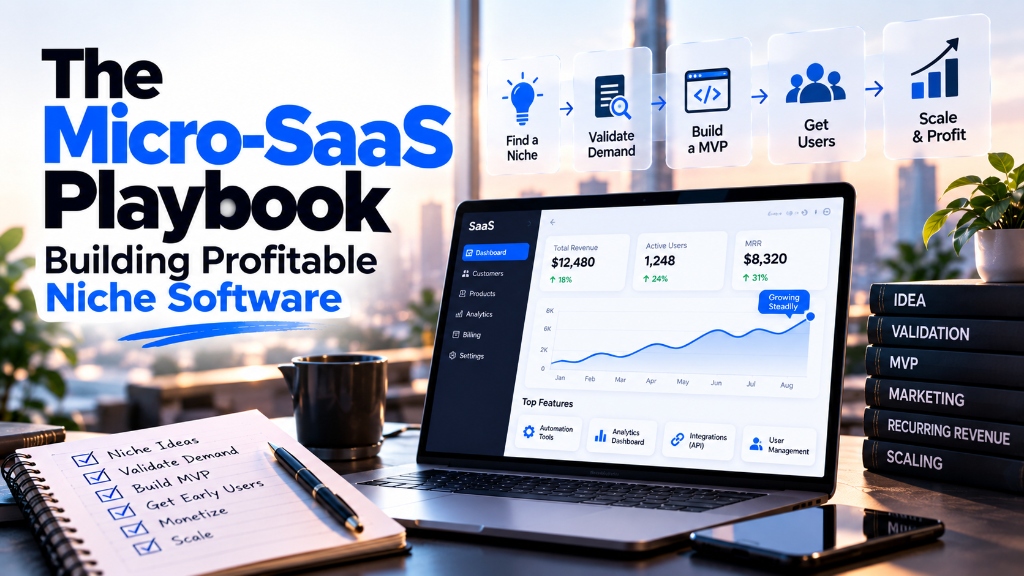
The Micro-SaaS Playbook: Building Profitable Niche Software
How solo developers and small teams build, launch, and scale high-margin niche software products to $10k+ recurring monthly revenue.
Disclaimer: This article is for educational purposes only and does not constitute financial or legal advice. We may earn an affiliate commission on links at no cost to you.
Read full disclaimer ↓Listen to "The Micro-SaaS Playbook: Building Profitable Niche Software"
Natural Voice Synthesis • Hands-free listening
Building a profitable Micro-SaaS requires targeting hyper-specific operational problems inside existing software ecosystems rather than attempting to build horizontal enterprise platforms. Solo developers scale Micro-SaaS products to $10,000+ monthly recurring revenue (MRR) by keeping engineering scope minimal and profit margins above 85%.
Micro-SaaS is a business model where a solo founder or small team builds a lightweight software tool solving a single workflow pain point for a defined niche audience. Success relies on leveraging existing platform marketplaces (Shopify, Salesforce, Chrome Web Store), pricing for B2B ROI, and maintaining a lean serverless tech stack.
What defines a True Micro-SaaS Business?
A Micro-SaaS business operates with minimal headcount, zero venture capital dependencies, and a razor-sharp focus on a narrow target market. Unlike venture-backed software companies chasing billion-dollar total addressable markets, Micro-SaaS founders build self-funded products targeting $100,000 to $500,000 in annual recurring revenue (ARR).
The ecosystem plugin advantage
building standalone web applications requires acquiring customers from scratch across noisy digital channels. In contrast, building plugins or add-ons for established software ecosystems grants immediate access to millions of active buyers looking for solutions.
High-Opportunity SaaS Ecosystems:
- E-Commerce Marketplaces: Shopify App Store, WooCommerce extensions.
- CRM and Productivity Engines: Salesforce AppExchange, HubSpot Marketplace, Notion Integrations.
- Workflow Platforms: Zapier integrations, Slack Apps, Chrome Web Store extensions.
[ Platform Marketplace (Shopify / Salesforce) ]
                     │
         [ Built-in Search Traffic ]
                     │
    [ Your Micro-SaaS Plugin (Solves 1 Pain Point) ]
                     │
       [ $49 - $199 / Month Recurring Subscription ]
Strategic comparison: Micro-SaaS vs Venture SaaS
| Metric | Micro-SaaS Model | Venture-Backed SaaS Model |
|---|---|---|
| Target Monthly Revenue | $5,000 - $30,000 MRR | $1,000,000+ MRR |
| Gross Profit Margin | 85% - 95% | 60% - 75% (High Sales/Marketing Spend) |
| Engineering Team Size | 1 - 2 Solo Builders | 20 - 100+ Engineers |
| Customer Acquisition Cost | Low (Marketplace Search) | High (Paid Ads & Enterprise Sales Teams) |
| Founder Equity Ownership | 100% Retained Equity | 10% - 25% Post-Dilution |
How to Build and Launch a Micro-SaaS in 4 Steps
Executing a Micro-SaaS strategy demands ruthlessly trimming feature scope to ship an initial working version within 30 days.
- Mine Ecosystem Marketplaces for Low-Star Reviews: Search app stores like Shopify or Chrome for popular plugins with 3-star reviews to discover persistent customer complaints.
- Build a Minimum Viable Product (MVP): Engineer a lightweight solution addressing that single missing feature, utilizing serverless backends to keep monthly hosting costs under $50.
- Price for B2B Value Realization: Charge flat monthly tiers ($29, $79, $199) tied to revenue expansion or hours saved, avoiding unsustainable $5/month pricing traps.
- Automate Customer Onboarding and Support: Record interactive video tutorials, build self-serve help docs, and integrate automated transactional emails to minimize daily support tickets.
Real world case example: Niche Invoice Automation
Consider a developer who observes Shopify store owners complaining on Reddit about manually generating tax-compliant PDF invoices for European customers.
Instead of building a full accounting platform, the developer spends three weeks creating a Shopify plugin called “EU Auto-Invoice Express”. The app does exactly one thing: automatically generates and emails localized PDF invoices whenever an order processes.
The developer charges $29/month per store. Within 12 months, 400 Shopify merchants install the app, generating $11,600 in monthly recurring revenue ($139,200 ARR). Hosting costs run $80/month on serverless infrastructure, allowing the developer to retain $11,400 net monthly profit with five hours of weekly maintenance.
Frequently asked questions
what’s the ideal monthly subscription price for Micro-SaaS?
The ideal monthly price range for B2B Micro-SaaS is $29 to $149 per month. Pricing below $20 requires thousands of customers to achieve viability while attracting high-support churn, whereas pricing above $300 often requires phone-based enterprise sales.
How do you prevent bigger competitors from copying your Micro-SaaS?
Competitors rarely copy focused Micro-SaaS tools because the target market size ($100k-$500k ARR) is too small for large venture firms to care about. Protect your market share through excellent customer support, fast platform updates, and deep niche workflow integrations.
Should I use no-code tools to build a Micro-SaaS?
No-code tools like Bubble or FlutterFlow are excellent for launching initial MVPs and testing market demand. However, custom code built on modern frameworks (React, Node, Astro, Postgres) delivers superior speed, customization, and lower long-term server costs as active subscriber volume scales.
Download: The Capital Allocation & Wealth Framework PDF
Get our comprehensive 30-page strategic PDF guide covering asset allocation, business moats, and mental models for long-term compounding.
- High-margin enterprise checklist
- Asset allocation proportion matrix
This article and its associated calculators are for educational and informational purposes only and do not constitute financial, investment, legal, tax, or medical advice. We may earn an affiliate commission on third-party links at zero cost to you. Always consult a licensed professional before making major financial, health, or investment decisions. Read our full Legal & Financial Disclaimer.
Written by Eternity Empire Editorial Team
The Eternity Empire editorial team analyzes personal finance, capital allocation, business strategy, and long-term wealth preservation frameworks.
Was this essay valuable to you?
Help us refine our editorial focus and research priorities.
Reader Discussion (2)
Extremely well-articulated analysis on capital compounding. The breakdown on equity allocation vs active income is spot on.
The distinction between looking rich and building real moats is something more founders need to study deeply.
Explore Eternity Empire
Search insights, browse categories, and discover featured publication guides.
Search Insights
Recent Insights
Further Wisdom & Insights
Explore All Articles →
The Psychology of Long-Term Thinking in a Distracted World
How high performers resist short-term dopamine loops, optimize for second-order consequences, and build compound advantages over 10-year horizons.
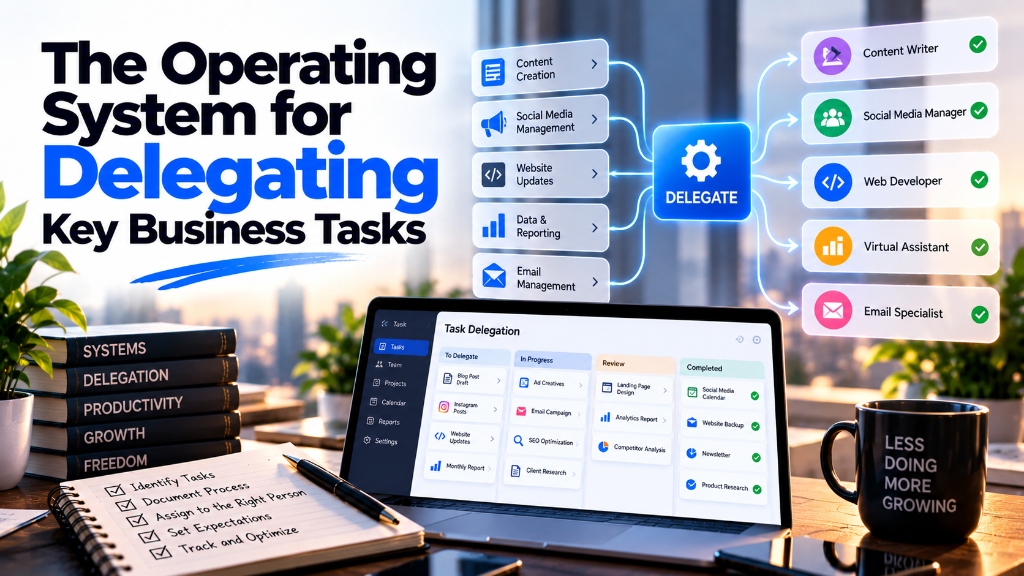
The Operating System for Delegating Key Business Tasks
How entrepreneurs delegate operational tasks effectively using outcome-based accountability, SOP documentation, and async workflows.

The Art of Saying No: Protecting Your Highest-Leverage Time
How top executives decline low-value commitments, set strict calendar boundaries, and protect focus time for high-advantage business activities.