

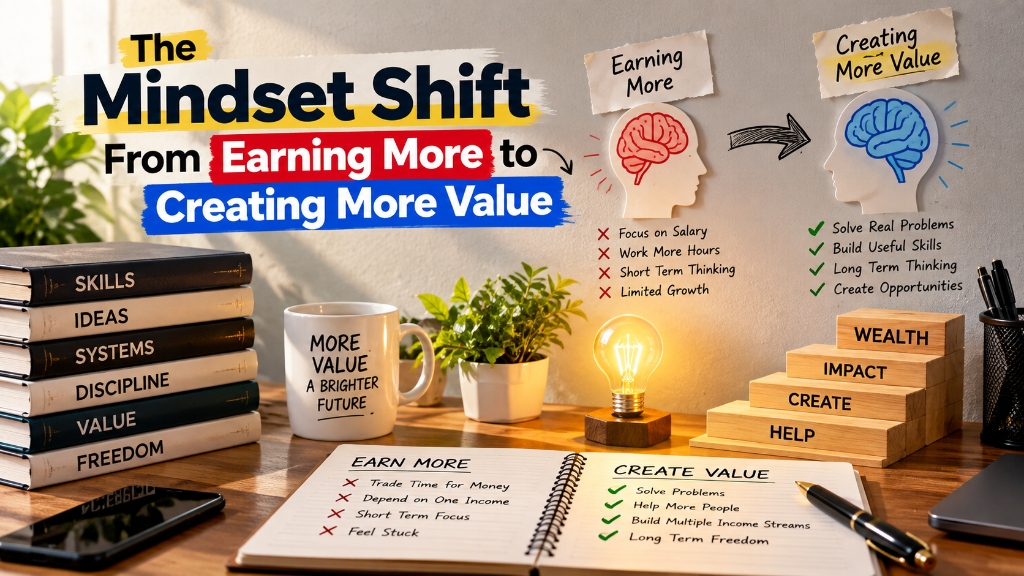
The Mindset Shift From Earning More to Creating More Value
Why focusing directly on money limits your income, and how pivoting to high-advantage value creation unlocks exponential returns.
Disclaimer: This article is for educational purposes only and does not constitute financial or legal advice. We may earn an affiliate commission on links at no cost to you.
Read full disclaimer ↓Listen to "The Mindset Shift From Earning More to Creating More Value"
Natural Voice Synthesis • Hands-free listening
The mindset shift from earning more to creating more value requires transitioning your focus from trading time for dollars to solving high-stakes problems at scale. The open market doesn’t compensate individuals based on personal financial need or hours worked; compensation is a direct function of problem difficulty and distribution scale.
Obsessing over money leads to linear income negotiation, whereas focusing on value creation produces exponential financial growth. Market compensation reflects problem complexity and scale. To increase income significantly, acquire high-advantage specialized skills, solve expensive enterprise problems, and distribute solutions through scalable digital channels.
The flaw of Linear Income Thinking
Most working professionals view financial compensation through a linear lens: trading hours of physical presence for a paycheck. This mindset leads to incremental strategies: negotiating 3% annual cost-of-living raises, working unpaid overtime, or picking up second hourly jobs.
Market economics doesn’t reward internal effort or financial need. Market economics rewards unique value delivered to counter-parties.
You are paid in direct proportion to the difficulty of the problems you solve for others and the scale at which you solve them.
Linear Thinking: Time Expended ==> Hourly Wage ==> Capped Income
Value Thinking: Acute Problem Solved ==> Scale Multiplier ==> Compounding Equity
How to Scale Value Output in 3 Steps
Transform your economic model from hourly time sales to scalable value creation using these three steps:
Step 1: Master High-Leverage Specialized Skills
High-advantage skills require specialized training to master but generate outsized economic impact when applied. Key examples include software engineering, capital deployment, brand positioning, copywriting, and enterprise sales.
Step 2: Solve Complex, Expensive Problems
Tackling simple problems yields simple compensation. Focus your energy on resolving high-friction enterprise bottlenecks: reducing customer churn, automating supply chain delays, or improving acquisition conversion rates.
Step 3: Package Value for Scalable Distribution
Decouple problem solving from manual hours by packaging solutions into reusable digital assets, software products, media resources, or systematic frameworks.
Practical example: Hourly Consultant vs. Productized Framework
Consider two marketing professionals serving small businesses:
- Consultant A (Hourly Mindset): Charges $75 per hour for custom marketing advice. To earn $150,000 annually, Consultant A must bill 2,000 hours per year, leaving zero capacity for growth or rest.
- Consultant B (Value Creation Mindset): Engineers a standardized lead-generation software system that increases client revenue by $50,000 per year. Charges $5,000 per year per client. With 50 client subscriptions, Consultant B earns $250,000 annually working 20 hours a week on system updates.
Comparison: Earning Mindset vs. Value Creation Mindset
| Dimension | Earning Mindset | Value Creation Mindset |
|---|---|---|
| Primary Question | “How do I get a raise?” | “What expensive problem can I solve?” |
| Unit of Exchange | Hours of labor | Scalable problem resolution |
| Income Ceiling | Hard cap (24 hours/day limit) | Unlimited (Scalable distribution) |
| Risk Factors | Vulnerable to lay-offs | High market advantage & adaptability |
| Market Perception | Commodity expense line | Essential value-generating asset |
Common pitfalls and Strategic Risks
Avoid these common traps when shifting toward value creation:
- Confusing Effort With Value: Working 80 hours a week on a task nobody wants to pay for produces zero economic return. Verify market demand before building.
- Neglecting Distribution: Creating a valuable solution without distribution leaves it undiscovered. Pair skill mastery with media or sales channels.
- Pricing Based on Cost Rather Than Value: Charging based on your build cost rather than the client’s financial benefit leaves significant value on the table.
Frequently asked questions
what’s a high-advantage skill?
A high-advantage skill is a capability where the economic output generated far exceeds the physical hours required to execute it, such as software development or copywriting.
How do I identify expensive problems worth solving?
Look for operational bottlenecks in businesses where manual labor creates delays, customer churn occurs, or prospective revenue is lost due to poor conversion.
Can employees apply value creation thinking within a company?
Yes. Intrapreneurs who identify internal cost leaks, automate redundant team workflows, or launch new revenue channels quickly earn promotions and equity participation.
Strategic recommendation
stop asking “How do I make more money this year?” Start asking “What $100,000 problem can I solve for ten organizations?” and map out your solution plan today.
Download: The Capital Allocation & Wealth Framework PDF
Get our comprehensive 30-page strategic PDF guide covering asset allocation, business moats, and mental models for long-term compounding.
- High-margin enterprise checklist
- Asset allocation proportion matrix
This article and its associated calculators are for educational and informational purposes only and do not constitute financial, investment, legal, tax, or medical advice. We may earn an affiliate commission on third-party links at zero cost to you. Always consult a licensed professional before making major financial, health, or investment decisions. Read our full Legal & Financial Disclaimer.
Written by Eternity Empire Editorial Team
The Eternity Empire editorial team analyzes personal finance, capital allocation, business strategy, and long-term wealth preservation frameworks.
Was this essay valuable to you?
Help us refine our editorial focus and research priorities.
Reader Discussion (2)
Extremely well-articulated analysis on capital compounding. The breakdown on equity allocation vs active income is spot on.
The distinction between looking rich and building real moats is something more founders need to study deeply.
Explore Eternity Empire
Search insights, browse categories, and discover featured publication guides.
Search Insights
Recent Insights
Further Wisdom & Insights
Explore All Articles →
The Psychology of Long-Term Thinking in a Distracted World
How high performers resist short-term dopamine loops, optimize for second-order consequences, and build compound advantages over 10-year horizons.

How to Overcome Imposter Syndrome in High Stakes Roles
How executives and founders reframe internal self-doubt, build objective evidence logs, and master high-responsibility positions.

How to Make High Stakes Decisions with Incomplete Data
How top executives apply the 70% information rule, differentiate Type 1 from Type 2 decisions, and prevent analysis paralysis.